
The Return of Total Environments: Immersive Architecture
For the last two decades, much of contemporary architecture and interior design has pursued the same ideal: restraint. Neutral palettes. Soft minimalism. Desaturated materials. Clean detailing. Spaces optimized for flexibility, photography, and broad-market appeal.
The result is often elegant. And also strangely forgettable.
A lot of contemporary environments are designed to avoid offending anyone rather than deeply affecting anyone. They function well. They photograph well. But psychologically, they barely register.
Meanwhile, another lineage of spatial design has quietly re-emerged online — rediscovered through scattered archival photography, niche architecture accounts, and growing fatigue with sterile contemporary environments. Total environments. These projects weren’t interested in disappearing into the background. They wanted to create worlds.
The Architecture of Spectacle
The interiors of John C. Portman Jr. still feel futuristic because they understood something contemporary commercial environments often suppress: scale can produce emotion.
His atriums weren’t simply large. They were cinematic. Escalators drifted through cavernous voids. Balconies stacked endlessly upward. Hanging sculptures floated through shafts of filtered light. Reflective metals, smoked glass, vegetation, carpet, water, and amber lighting merged into a single atmospheric system.
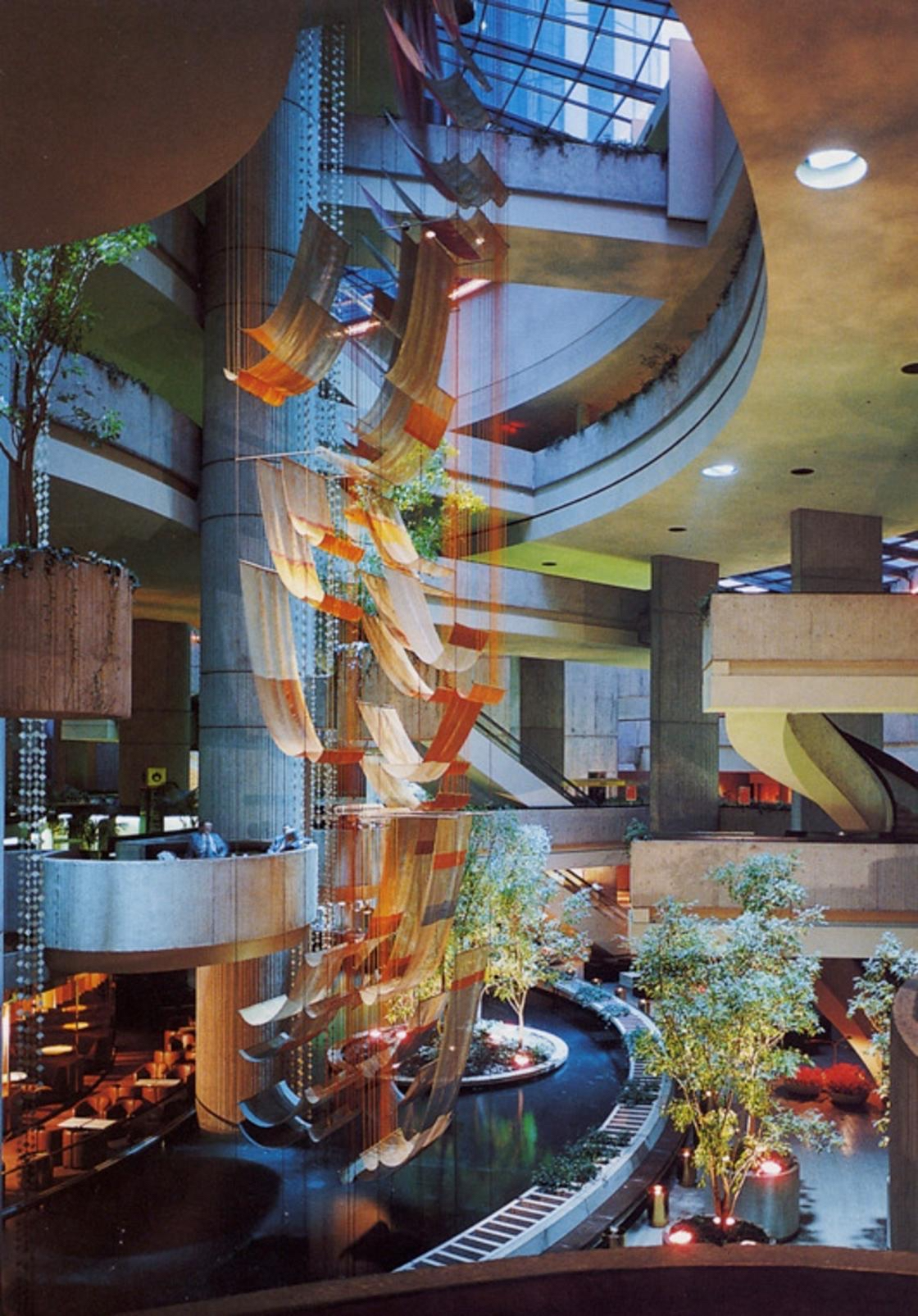
Detroit Plaza Hotel by John Portman
These spaces were immersive before immersion became a category.
Importantly, the experience wasn’t dependent on digital media. The architecture itself generated the sensation through spatial sequencing, material reflectivity, acoustic softness, and controlled lighting conditions.
Even the color palettes mattered. Burnt orange, tobacco brown, champagne brass, olive green — the now-reviled tones of late 1970s interiors suddenly feel emotionally rich again compared to today’s endless grayscale hospitality spaces.
Portman’s environments understood that people remember atmosphere long after they forget floor plans.
Color as Total Perception
Verner Panton approached interiors less like rooms and more like perceptual experiments.
His spaces dissolved conventional distinctions between furniture, wall, ceiling, and object. Everything participated in the same chromatic and geometric language. Curves flowed continuously into seating. Light became color. Color became atmosphere. Atmosphere became psychology.
What makes this work feel contemporary again is that it rejected neutrality entirely.
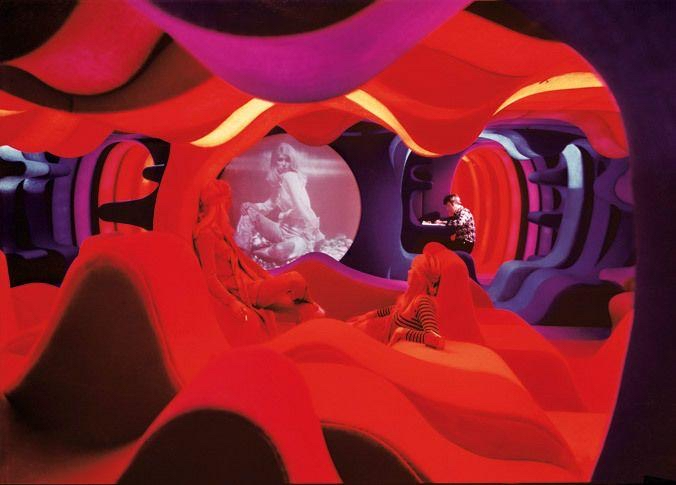
Phantasy Landscape (aka "living cave") by Danish architect and designer Verner Panton
Panton understood immersion as coherence. When every spatial element participates in the same emotional frequency, the environment stops feeling decorated and starts feeling total. The user doesn’t simply observe the room — they enter a constructed sensory condition.
A lot of current “immersive experiences” misunderstand this. They rely on temporary media overlays attached to otherwise generic architecture. Panton’s work suggests a more difficult and far more powerful approach: the environment itself must become the medium. Not screens added to space.
Architecture as Graphic Communication
Projects like Ni-Ban-Kahn by Minoru Takeyama feel almost impossible by contemporary development standards. The building behaves simultaneously as architecture, signage, stage set, urban artifact, and graphic composition. Overscaled targets wrap facades. Stripes distort scale. Volumes collide with cartoon-like confidence. The entire project feels communicative rather than restrained.
And honestly, cities could use more of this energy.
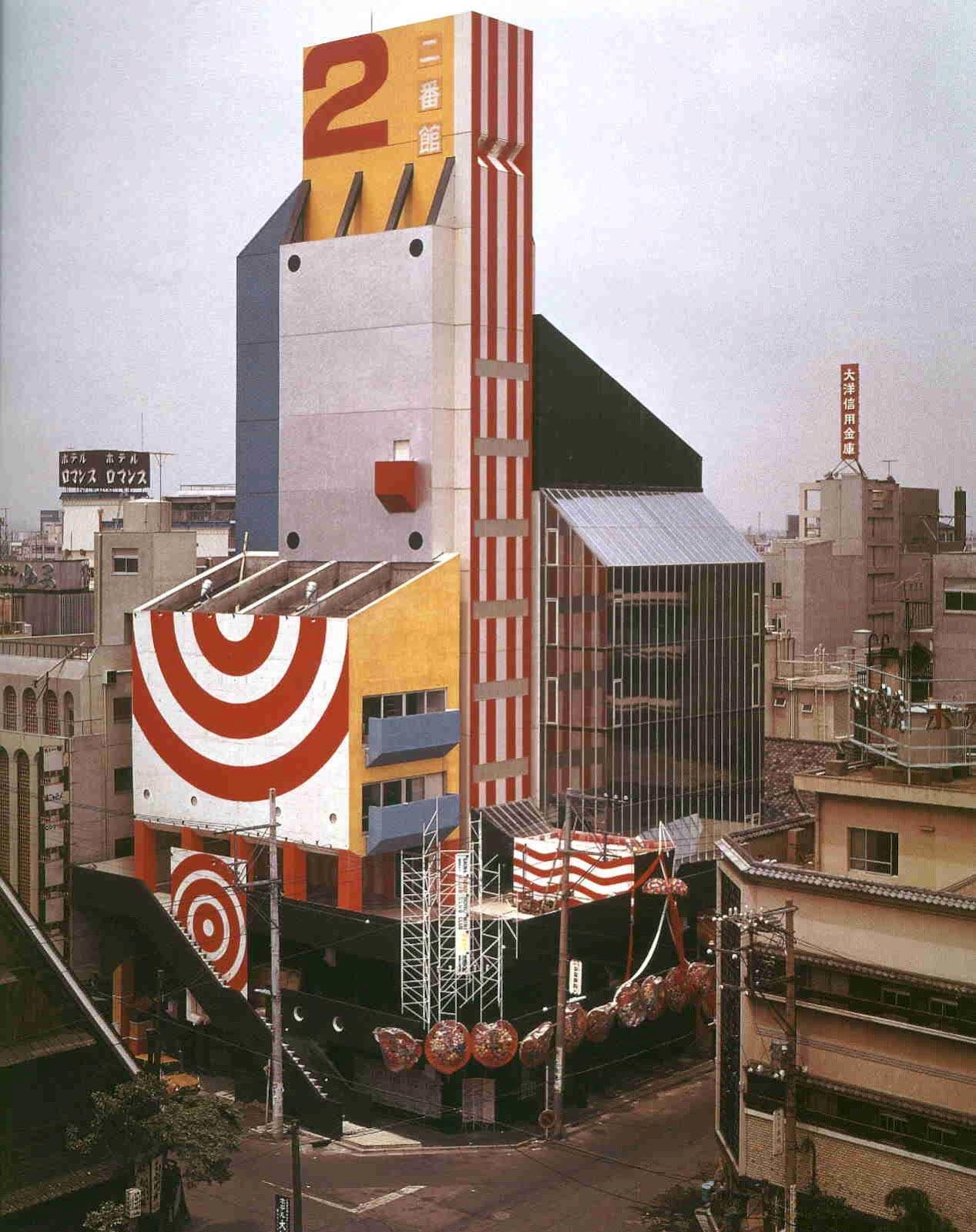
Ni-Ban-Kahn by Minoru Takeyama
Contemporary architecture often defaults to abstraction because abstraction feels safe. But hyper-neutral environments frequently become culturally invisible. Takeyama’s work reminds us that strong visual identity can create memory, orientation, and emotional attachment. There’s also something deeply urban about it. The building doesn’t isolate itself from visual culture — it absorbs it. Advertising language, pop graphics, theatricality, and symbolic form become architectural material.
That willingness to engage visual noise rather than escape it feels increasingly relevant in contemporary cities saturated with media.
Light as Material
The reconstructed Kaiser Wilhelm Memorial Church demonstrates a completely different kind of immersion. Atmosphere. The blue stained-glass enclosure transforms daylight into a total environmental condition. Light no longer behaves as illumination alone. It becomes spatial substance. The interior feels submerged rather than lit.
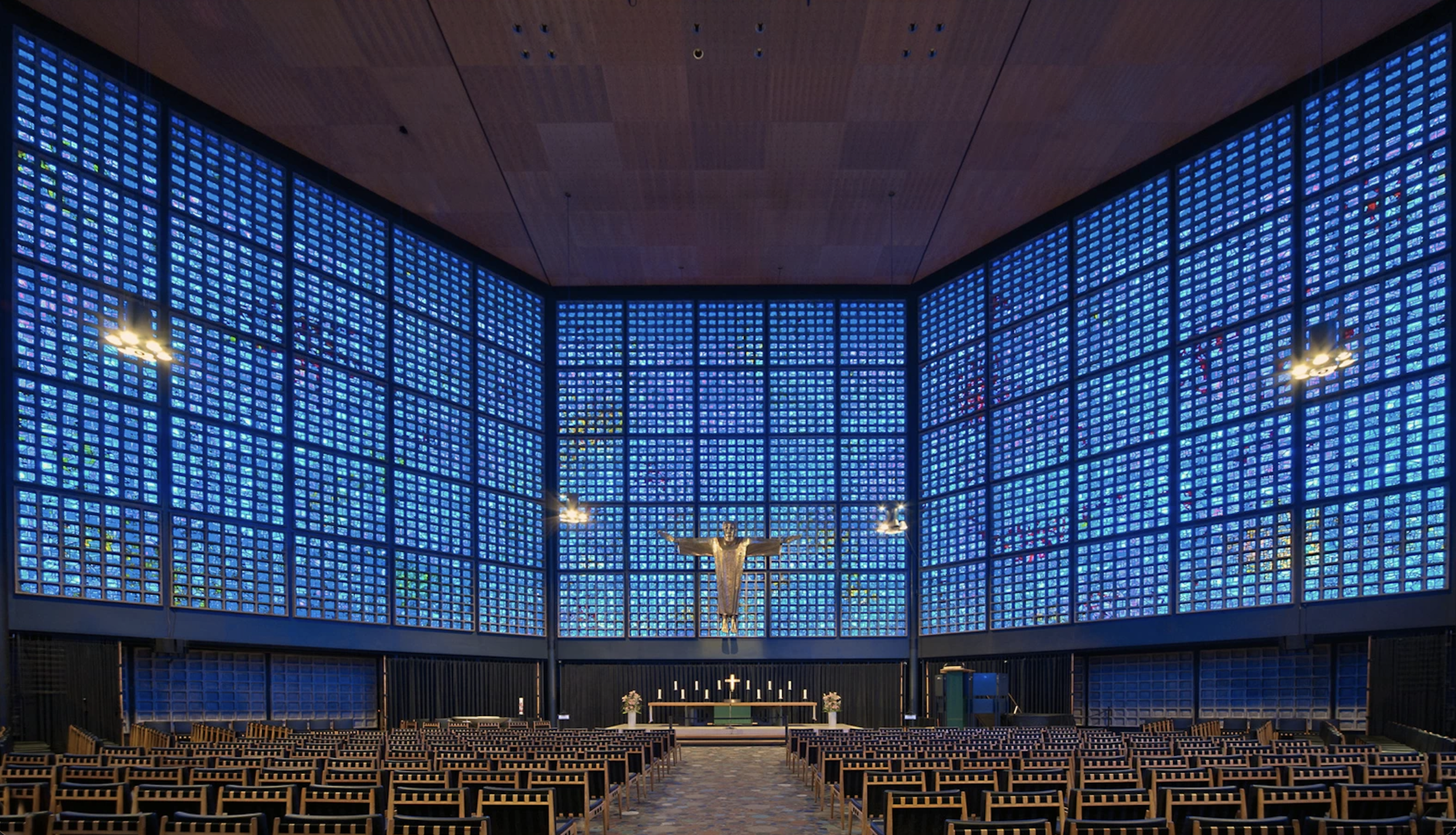
Kaiser-Wilhelm-Gedächtniskirche by Egon Eiermann
Some of the most powerful spaces in architectural history are remembered primarily through ambient sensation: the darkness of Gothic cathedrals, the gold haze of Byzantine interiors, mirrored disco environments, casinos engineered around artificial twilight, and the neon urbanism in Tokyo and Hong Kong. Atmosphere is constructed with precision. Light temperature. Reflection. Absorption. Color density. Acoustic softness. Spatial compression. Temporal variation. These are not decorative afterthoughts. They are emotional infrastructure.
The Decline of Atmospheric Ambition
What ties these precedents together is not style. It’s ambition.
They were trying to produce complete emotional worlds rather than neutral containers for activity. They embraced theatricality, identity, color, graphic intensity, spatial drama, and perceptual manipulation without embarrassment. Contemporary design culture often treats these qualities with suspicion. Too expressive becomes unserious. Too atmospheric becomes commercial. Too emotional becomes excessive. But increasingly, people are exhausted by frictionless neutrality.
The popularity of archival interiors online is not simply nostalgia. It reflects a broader hunger for environments with psychological character — places that feel authored rather than optimized.
Spaces capable of wonder.
Spaces capable of tension.
Spaces capable of seduction.
Spaces capable of memory.
We’re increasingly interested in what these environments suggest for contemporary spatial practice—not as retro revivalism or aesthetic mimicry, but as a return to designing atmosphere intentionally. A return to treating color as an environmental system, graphics as spatial identity, light as material, and architecture itself as a form of emotional sequencing. These precedents point toward immersive environments that don’t depend on screens or spectacle alone, but instead emerge through the integration of installation, form, acoustics, reflection, scale, and sensation into a unified spatial experience. Long before “immersive” became an industry buzzword, it was already an architectural idea: the deliberate shaping of perception through matter itself.
That lineage has unfinished potential.