
Resonance: Public Art Through Perspective
Resonance by Immersive Material Office
Public space is often defined by architecture. Columns, walls, circulation paths, and structural systems establish the framework within which civic life unfolds. But buildings alone do not create public experience. People do.
That idea became the foundation of Resonance, our finalist proposal for the Salem Civic Center Public Art Project in Salem, Oregon.
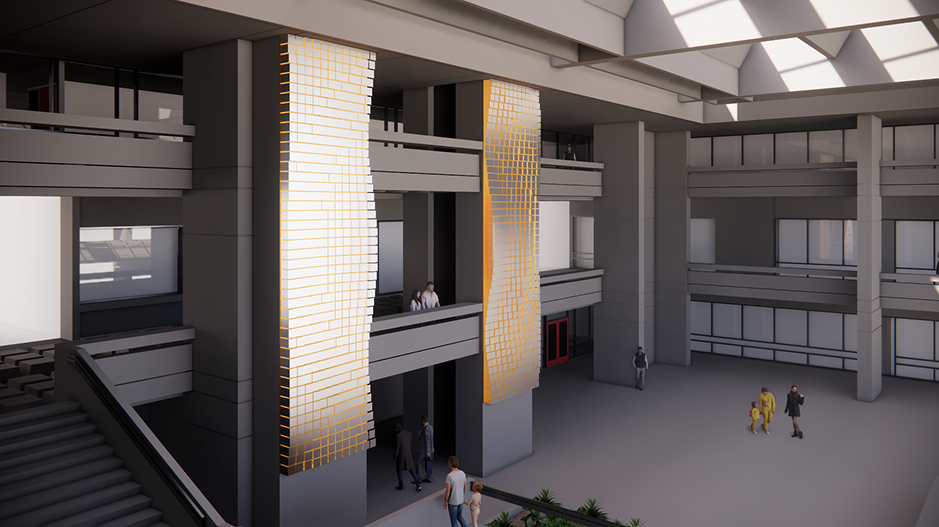
Located within the Civic Center's monumental atrium, the project sought to explore the relationship between civic space and civic participation. The atrium functions as a shared public living room where government, community, and daily life intersect. Workers, visitors, elected officials, and residents all move through the same space, each bringing a unique perspective to the building and to the city itself.
Rather than introducing a singular object into the environment, we were interested in creating an artwork that could express the collective nature of civic identity.
Designing for Movement
The Salem Civic Center is known for its striking Brutalist architecture. Its exposed concrete structure, repetitive rhythms, and monumental scale communicate permanence, stability, and institutional presence. Rather than competing with those qualities, Resonance was conceived as a complementary intervention.
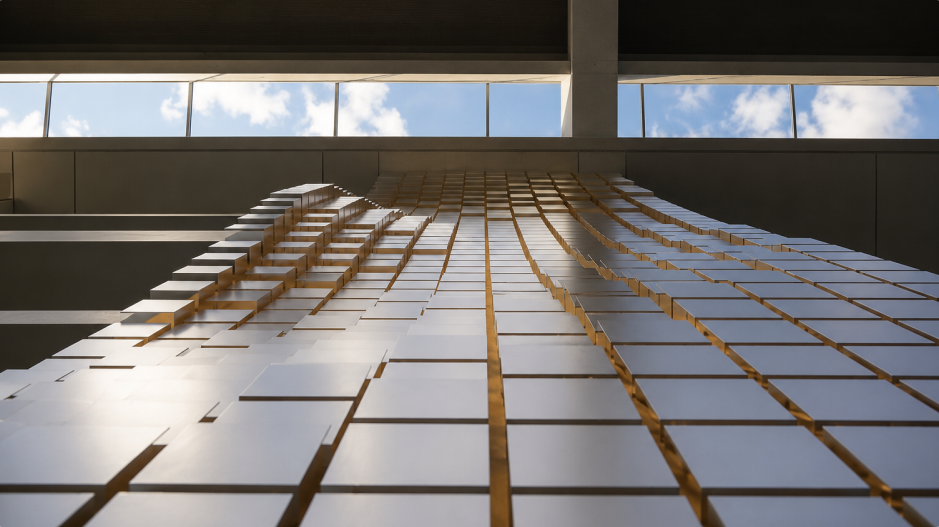
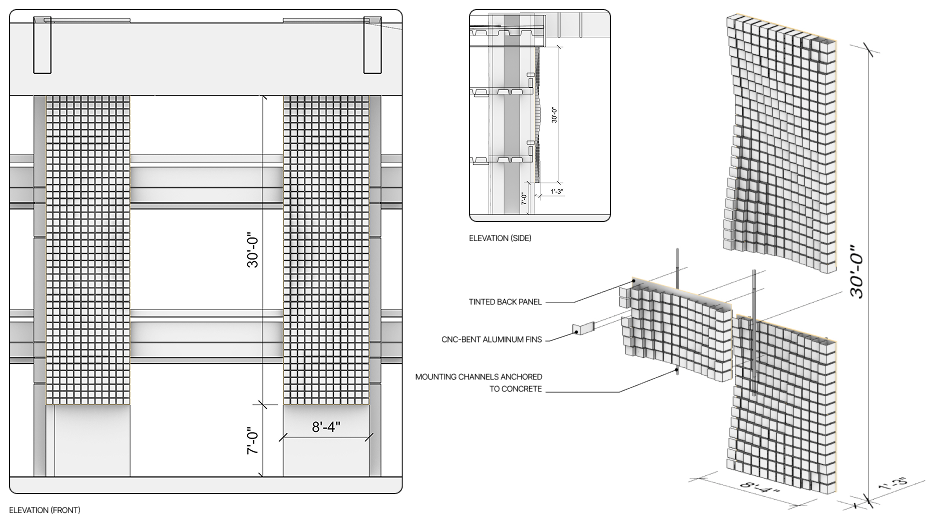
The proposal transformed two existing columns into layered sculptural fields composed of hundreds of folded aluminum fins. From a distance, the installation appeared as a cohesive visual form. Surfaces seem to bend, ripple, dissolve, and reassemble through shifting perspective, reflection, and shadow.
The effect was achieved entirely through fixed geometry. No moving parts. No digital systems. No screens.
Instead, the work relied on the relationship between form, light, and human movement to create an experience that remained dynamic throughout the day.
Parallax as Participation
One of the central ideas behind Resonance was the phenomenon of parallax: the perceptual shift that occurs when a viewer changes position relative to an object.
As visitors moved through the atrium, layers of fins aligned and separated. Colors intensified or disappeared. Depth expanded and compressed. The artwork never presented a single fixed image. Instead, it produced a constantly changing experience dependent on the viewer's position.
This became both a visual strategy and a civic metaphor.
Communities are not defined by a singular viewpoint. They emerge through the accumulation of many perspectives, voices, and experiences. The installation translated that idea into physical form, allowing visitors to experience the work differently depending on where they stood and how they moved through the space.
The artwork was not complete without participation.
Working With Architecture, Not Against It
Many public art projects occupy a site. Fewer engage the architecture itself as a medium.
For Resonance, the existing columns became the canvas, structure, and conceptual framework for the work. The installation amplified the rhythm already present within the atrium while introducing permeability, color, and visual movement into an otherwise monochromatic environment.
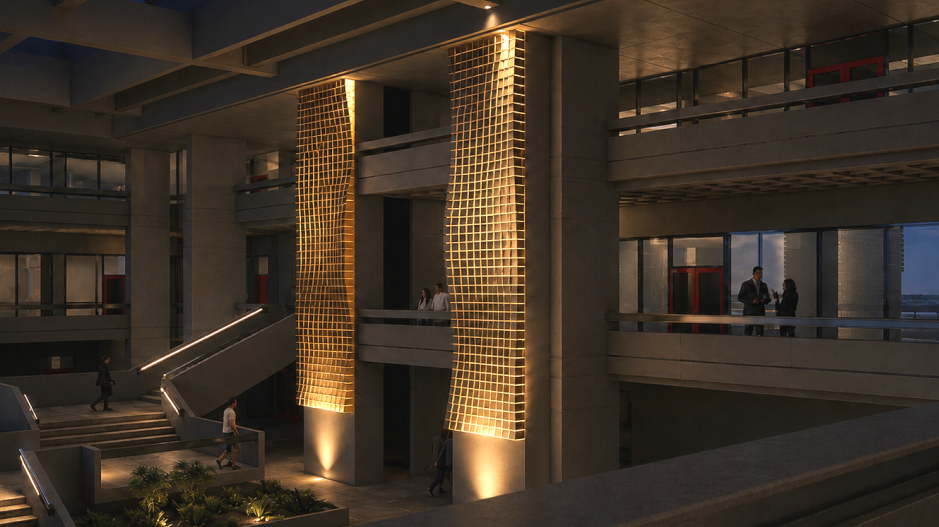
The goal was not to obscure the building but to reveal new ways of seeing it.
From the atrium floor, the work would appear differently than from upper balconies. Visitors ascending stairs would encounter different alignments than those moving across the open floor. The architecture became an active participant in the experience, creating a layered dialogue between structure, light, and movement.
Material Honesty
The proposal drew inspiration from one of Brutalism's defining principles: truth in materials. The visual richness of the installation emerged directly from its construction rather than from applied ornamentation. Bent aluminum fins, exposed depth, reflected light, and carefully calibrated color relationships produced the work's visual effects.
Aluminum was selected for its durability, corrosion resistance, and ability to maintain a refined appearance within a high-traffic civic environment. The installation was designed to be robust, maintainable, and capable of remaining relevant over decades of public use. Like the building itself, the artwork was intended to age gracefully.
Beyond Salem
Public spaces succeed when they encourage people to engage with one another and with their surroundings in new ways. We’d like to thank the City of Salem, the selection committee, and community members who made the opportunity possible.
While Resonance was designed specifically for Salem Civic Center, the underlying principles extend beyond a single site. The relationship between movement and perception, individual and collective experience, permanence and participation, are questions shared by civic environments everywhere. If you’re exploring ways to activate a civic, cultural, or atrium/lobby spaces, we welcome the conversation.