
Show, Don’t Tell: The Toyota Dining Room Lesson
There’s a persistent myth in business that information changes behavior. That if you present enough data, enough insight, enough cleanly designed slides, people will eventually “get it.” In reality, most people don’t change their thinking because of information. They change because of experience. Understanding is not downloaded. It’s lived.
Decades ago, Toyota ran into this exact problem. Their U.S.-based design team was trying to explain to executives in Japan why American vehicles needed to be larger. They shared research, metrics, and user insights, but nothing landed. The executives understood the numbers, but they couldn’t feel what those numbers meant. So the team did something radically simple. They built a full-scale American dining room inside Toyota’s headquarters in Japan. A large table, wide chairs, generous spacing, everything calibrated to reflect everyday American life. The moment executives stepped into the room, the conversation changed. No debate. No persuasion. Just immediate clarity.
That installation didn’t just communicate an idea. It collapsed distance between knowledge and understanding. It turned abstraction into something physical, something undeniable. And in doing so, it proved a principle that now defines the future of design: if you want people to understand something differently, you have to let them step inside it.
This is the foundation of experiential design. Not spectacle for the sake of attention, but environments that actively reshape perception. At Immersive Material Office, this idea sits at the center of how installations are conceived. The goal is not to decorate space. The goal is to transform how people think, feel, and behave within it.
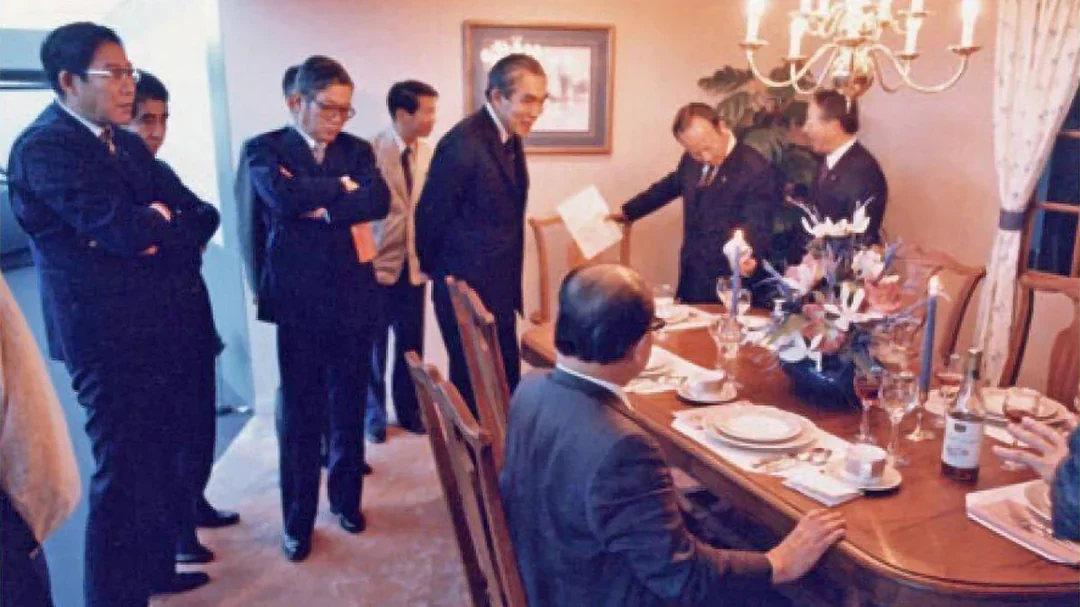
Japanese executives experiencing the American dining room mockup
The Failure of Information-First Thinking
We’re living in the most over-informed moment in history. Companies have access to more data than ever before. Customer journeys are mapped in detail. Behavioral analytics track nearly everything. AI tools generate insights at scale. And yet, decision-making still stalls. Misalignment persists. Teams struggle to translate knowledge into action.
The issue isn’t a lack of intelligence. It’s a mismatch between how information is delivered and how humans actually process meaning.
Most communication in business is designed for efficiency. Slides compress ideas. Reports summarize complexity. Dashboards flatten nuance into metrics. These formats are useful, but they strip away context. They remove scale, atmosphere, and physical relationship. They reduce lived experience into something abstract and distant.
The Toyota dining room worked because it reversed that process. Instead of compressing reality, it expanded it. It created a space where executives could physically encounter the problem. The size of the table, the spacing between chairs, the proportion of the room, all of it communicated something that no dataset could fully capture. It didn’t explain the insight. It made the insight unavoidable.
That distinction matters. Because people rarely change their minds when they are told something new. They change when they experience something that contradicts what they thought they knew.
Space as a Behavioral Interface
Every environment shapes behavior, whether it’s intentional or not. Walk into a cathedral and your voice drops. Enter a crowded retail store and your pace quickens. Step into a quiet gallery and your attention sharpens. These reactions aren’t conscious decisions. They’re responses to spatial cues.
Light, scale, material, sound, and circulation all influence how people move, where they focus, and how long they stay. This is the domain of environmental psychology, but it’s also the foundation of experiential design. Installations leverage these cues deliberately, turning space into a kind of interface between an idea and a person.
Instead of asking someone to intellectually process a concept, the environment does the work. It sets conditions that guide perception. It invites exploration. It creates friction or flow. It reveals or conceals. In this way, installations don’t just communicate messages. They orchestrate behavior.
That’s why the most effective experiential environments feel intuitive. People don’t need instructions. They understand through movement, through proximity, through interaction. The space teaches them.
Why Installations Work When Presentations Don’t
There’s a reason experiential installations are becoming a primary tool for brands, institutions, and cultural organizations. They tap into how humans are wired to learn.
First, spatial memory is incredibly strong. People remember places far more vividly than they remember abstract information. When you walk through an environment, your brain builds a mental map tied to sensory input and emotion. That map becomes a durable memory. It’s why you can recall the layout of a childhood home decades later, but struggle to remember the details of a presentation from last week.
Second, the body plays a critical role in understanding. Learning is not just a cognitive process. It’s physical. When you move through space, touch materials, and shift your perspective, multiple systems in the brain activate simultaneously. This creates a richer, more integrated form of learning. Installations take advantage of this by turning passive observers into active participants.
Third, emotion accelerates comprehension. Environments can evoke curiosity, tension, awe, or calm through subtle design decisions. These emotional responses anchor ideas in memory. A presentation might convince someone in the moment, but an experience lingers. It becomes something people return to mentally, often without realizing it.
Together, these factors create a powerful effect. Installations don’t just inform. They imprint.
Designing Physical Arguments
The most impactful installations operate as what could be called physical arguments. They don’t rely on explanation. They demonstrate a point through spatial conditions. The design itself becomes the thesis.
This requires a shift in thinking. Instead of asking how to communicate an idea, the question becomes: what environment would make this idea impossible to ignore?
One approach is translating abstract concepts into physical form. Scale, for example, is notoriously difficult to convey through numbers. But a large structure, an expansive volume, or an overwhelming field of elements can make scale immediately legible. Complexity can be expressed through layered systems or intricate assemblies. Time can be represented through sequential spaces that unfold as people move through them.
Another strategy is guiding discovery through movement. Installations can be designed as narratives that reveal themselves over time. As visitors progress, they encounter new information, new perspectives, and new relationships. This creates a sense of participation. People don’t just receive the story. They uncover it.
Perhaps most powerful is the ability to make invisible systems, visible. Many of the forces shaping our world, from data networks to ecological processes, operate beyond direct perception. Installations can translate these systems into something tangible. Light, material, and structure become proxies for otherwise intangible dynamics. When people can see and interact with these systems, understanding deepens quickly.
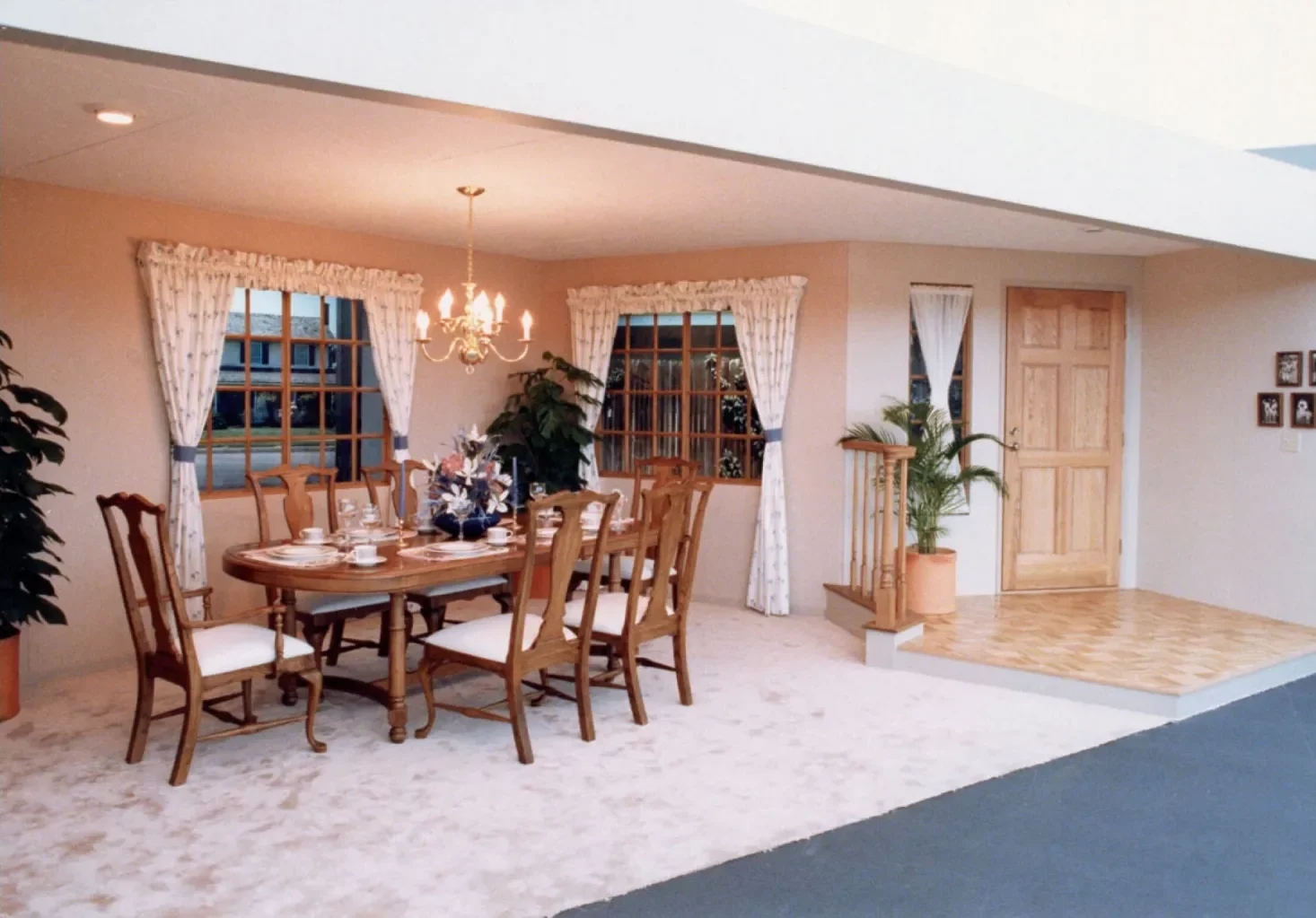
Toyota’s dining room mockup
The Shift Toward Experiential Understanding
The relevance of experiential design has grown alongside the complexity of the problems organizations face. Today’s challenges are often abstract, distributed, and difficult to grasp through traditional communication.
Artificial intelligence operates in layers most people never see. Climate systems unfold across scales that are hard to visualize. Supply chains span continents. Digital platforms exist in environments without physical form. Explaining these systems through text or diagrams has limits.
This is where installations become critical. They provide a way to externalize complexity, to give shape to things that would otherwise remain conceptual. As a result, more organizations are investing in environments designed specifically to create understanding.
Innovation labs simulate future scenarios so teams can interact with emerging technologies before they are fully realized. Brand activations translate digital ecosystems into physical experiences that audiences can explore. Museums and cultural institutions use immersive environments to bring history and science into the present moment. Even workplaces are evolving to reflect organizational values spatially, turning culture into something employees can physically navigate.
Across all of these contexts, the underlying principle is consistent. People trust what they experience.
From Messaging to Behavior Design
For brands, this shift represents a fundamental change in strategy. Traditional marketing is built around messaging. It focuses on what a brand says. Experiential design focuses on behavior. It shapes what people do, how they move, and what they feel.
This distinction is subtle but important. Messaging can be ignored. It competes for attention in an already saturated landscape. Environments, on the other hand, are immersive. When someone steps into a space, they are already engaged. The only question is what the space encourages them to notice, to explore, to remember.
This is why installations are becoming central to product launches, events, and permanent brand environments. They create moments where people are not just observers but participants. Instead of being told a story, they inhabit it.
The result is a deeper level of connection. People leave with a memory that feels personal. And because that memory is tied to physical experience, it tends to last.
What Toyota Revealed, and What Comes Next
The dining room Toyota built was never intended to be a blueprint for experiential design. It was a practical solution to a communication problem. But in hindsight, it revealed something essential about how humans understand the world.
We are not purely rational processors of information. We are spatial, sensory, emotional beings. We learn by encountering, by moving, by feeling scale and proportion and atmosphere.
When organizations design for that reality, they unlock a different kind of clarity. Conversations move faster. Alignment becomes easier. Ideas that once felt abstract become tangible.
At Immersive Material Office, installations are designed with this in mind. Each project begins with a question: what does the audience need to experience in order to understand this idea fully? From there, the design process focuses on constructing environments that deliver that experience with precision.
Sometimes that means revealing hidden systems. Sometimes it means amplifying scale. Sometimes it means creating moments of pause and reflection. The form changes, but the intent remains consistent.
Create a space where understanding happens naturally.
Because once someone has experienced an idea, they don’t need to be convinced of it. They’ve already seen it for themselves.