
The Architecture of Performance: Scenic Worldbuilding
For decades, the evolution of stage design was measured by technology. Larger LED walls. Brighter lighting rigs. Higher-resolution projections. More automation. As digital media became increasingly sophisticated, spectacle often became synonymous with technical complexity. The stage evolved into a platform for displaying content rather than shaping experience.
Today, some of the most influential scenic designers are moving in a different direction.
Rather than filling every surface with imagery, they are constructing singular architectural concepts. Monumental forms replace elaborate scenery. Landscapes replace decorative sets. Architecture becomes narrative rather than backdrop. Technology remains essential, but it increasingly recedes into the background, allowing space itself to become the primary medium through which stories are told.
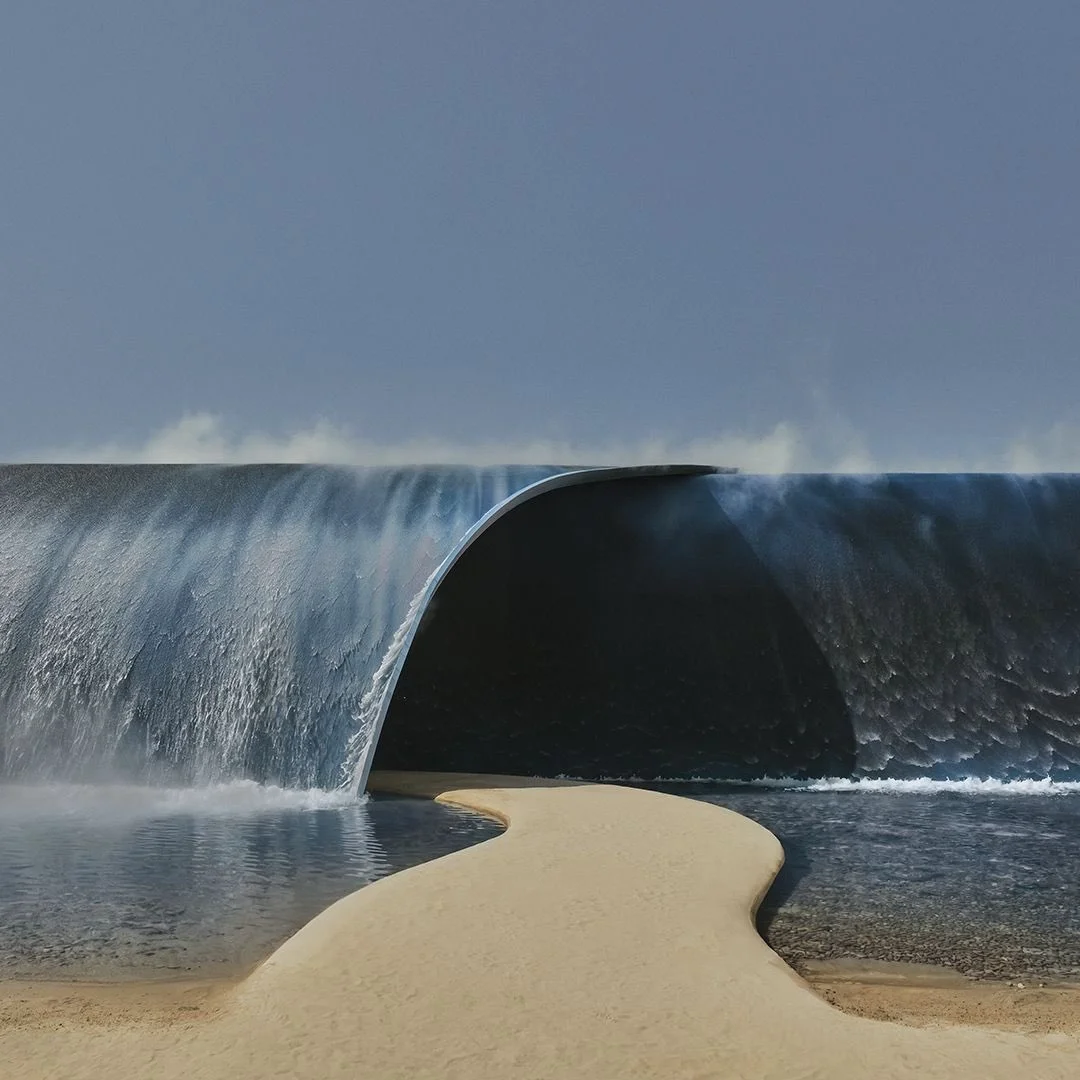
Pharrell Williams’ Men’s SS27 Louis Vuitton fashion show
What’s emerging is not simply a new aesthetic. It is a new methodology for immersive design. The strongest contemporary productions are no longer conceived as stages waiting to be activated by performers. They are complete worlds with their own geography, atmosphere, material language, and internal logic. Performers inhabit these worlds rather than simply standing within them, and audiences experience them less as spectators and more as temporary inhabitants.
Night after night, scenic designers are testing new relationships between architecture, landscape, choreography, material, and narrative at a scale few other disciplines can match. These environments must communicate instantly while rewarding sustained attention. They must function equally well from the front row, the upper deck, and through the lens of a smartphone. The constraints are immense, but so is the opportunity. As a result, contemporary performance has become one of the world’s most compelling laboratories for spatial experimentation.
The ideas explored in these productions rarely remain confined to entertainment. They migrate into museums, hospitality, retail, public art, workplaces, and cultural institutions, gradually reshaping expectations for how physical environments should feel and behave. Recent work by Kanye West, Pharrell Williams, Jason Ardizzone-West, and Es Devlin demonstrates that scenic design is no longer simply supporting performance—it is actively redefining the language of immersive spatial design.
Monument as Architecture
A massive cylindrical volume hovers impossibly above a hemispherical landscape occupied by only a handful of performers. There are almost no recognizable theatrical elements. No elaborate scenery. No attempt to recreate a literal place. Instead, the environment establishes its own reality through scale alone.
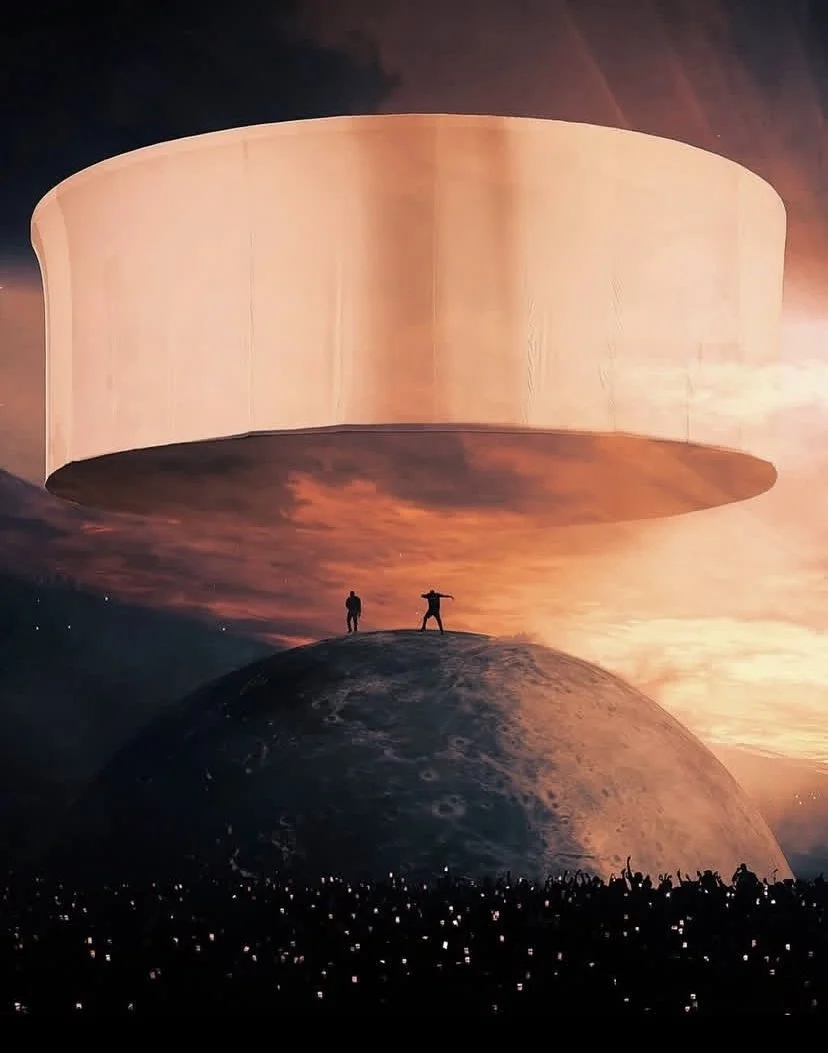
Ye’s performance at the SoFi Stadium
Standing beneath the suspended cylinder, the audience immediately loses any conventional understanding of proportion. The object feels almost indifferent to the thousands of people gathered below it. Rather than dominating the architecture, the performer becomes one element within it. Attention shifts away from personality and toward the environment itself.
This reversal is significant. Concert stages have traditionally been designed to amplify the performer. Here, the architecture amplifies the world surrounding the performer. The result feels less like attending a concert than participating in a ritual unfolding inside an unfamiliar civilization. Before a lyric is sung or a note is played, the spatial composition has already established emotional conditions that are simultaneously industrial, celestial, ancient, and speculative.
Perhaps most importantly, the stage demonstrates the power of reduction. In an era defined by infinite visual content, one monumental form possesses greater symbolic power than an endless sequence of digital imagery. Rather than overwhelming the audience with information, the environment invites interpretation, allowing each viewer to project their own meaning onto the architecture.
Landscape as Narrative
If Kanye’s work explores monumentality, Pharrell Williams’ recent Louis Vuitton runway investigates landscape as architecture.
A continuous topography rises from the ground before releasing a perfectly controlled waterfall that conceals and reveals the procession beyond. Water becomes enclosure. Gravity becomes choreography. The runway appears less like an object inserted into a venue than a geological formation emerging from it.
The waterfall initially obscures what lies beyond, replacing immediate comprehension with curiosity. As models emerge through the curtain of water, the landscape reveals itself sequentially, encouraging anticipation instead of instant recognition. Much like architecture or landscape design, the environment cannot be understood from a single viewpoint. It asks the audience to experience space through movement and time rather than through a single image. The landscape itself becomes the event.
Rather than assembling a collection of scenic elements, Ardizzone-West constructs an entire coastal world. A weathered lighthouse, grounded ship, rocky shoreline, and expansive horizon establish an environment that feels indebted as much to land art and environmental storytelling as it does to traditional scenic design.
What makes the production particularly compelling is that the landscape remains fundamentally consistent throughout the performance. Rather than rebuilding the stage for each song, lighting, choreography, music, and atmosphere continually transform the emotional reading of the same environment. Calm water becomes vulnerability. Storms introduce tension. Isolation becomes resilience. The world itself develops emotional depth without ever losing its identity.
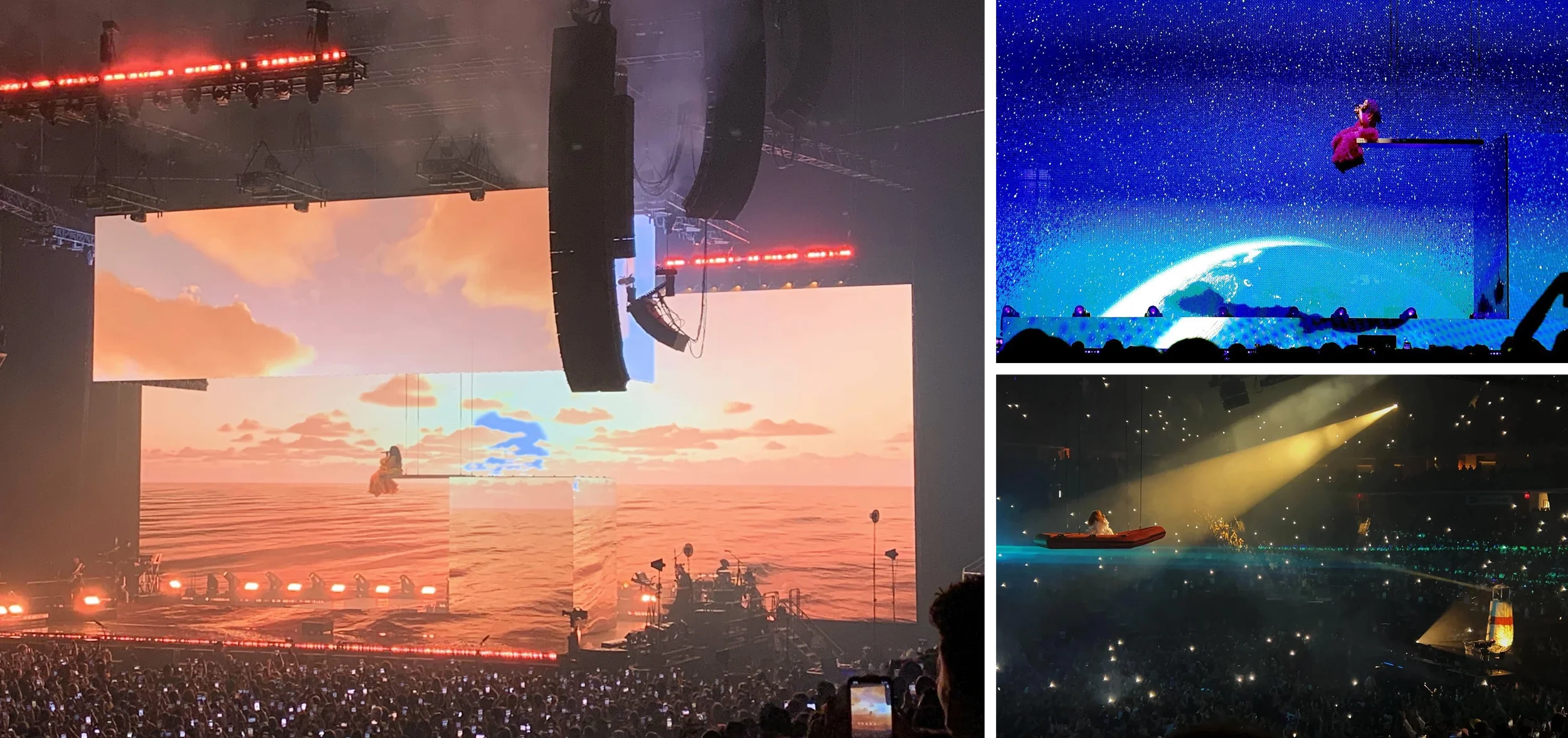
Jason Ardizzone-West’s scenic design for SZA’s SOS Tour
This consistency allows audiences to build a relationship with the environment over the course of the performance. The landscape ceases to function as scenery and begins to feel like another performer—one capable of expressing emotion alongside the artists who occupy it.
This represents an important shift in scenic design. Rather than asking what a particular song requires, designers are increasingly asking a broader question: what kind of world does this performance inhabit? That distinction fundamentally changes the role of architecture. Instead of illustrating individual moments, architecture establishes the conditions from which every moment emerges.
Architecture as Narrative
Across concerts, opera, theatre, and fashion, Es Devlin has consistently rejected the notion that architecture should serve as passive background. Her work treats space as an active participant capable of evolving alongside performers and audiences. Monumental rotating forms, sculptural volumes, reinterpreted architectural typologies, and kinetic environments shift continuously throughout a performance, dissolving the boundaries between architecture, sculpture, choreography, and storytelling.
Whether referencing classical architecture, abstract geometry, or civic monuments, her environments rarely describe a literal place. Instead, they establish emotional frameworks that performers inhabit and transform over time. Lady Gaga’s recent stage production, for example, frames performers beneath a monumental architectural façade. Whether experienced from the floor of the arena or captured through a smartphone, the composition reads immediately. It feels theatrical in person but almost cinematic in photographs, creating an image that audiences instinctively want to document and share. The architecture does not simply contain the narrative; it produces it.
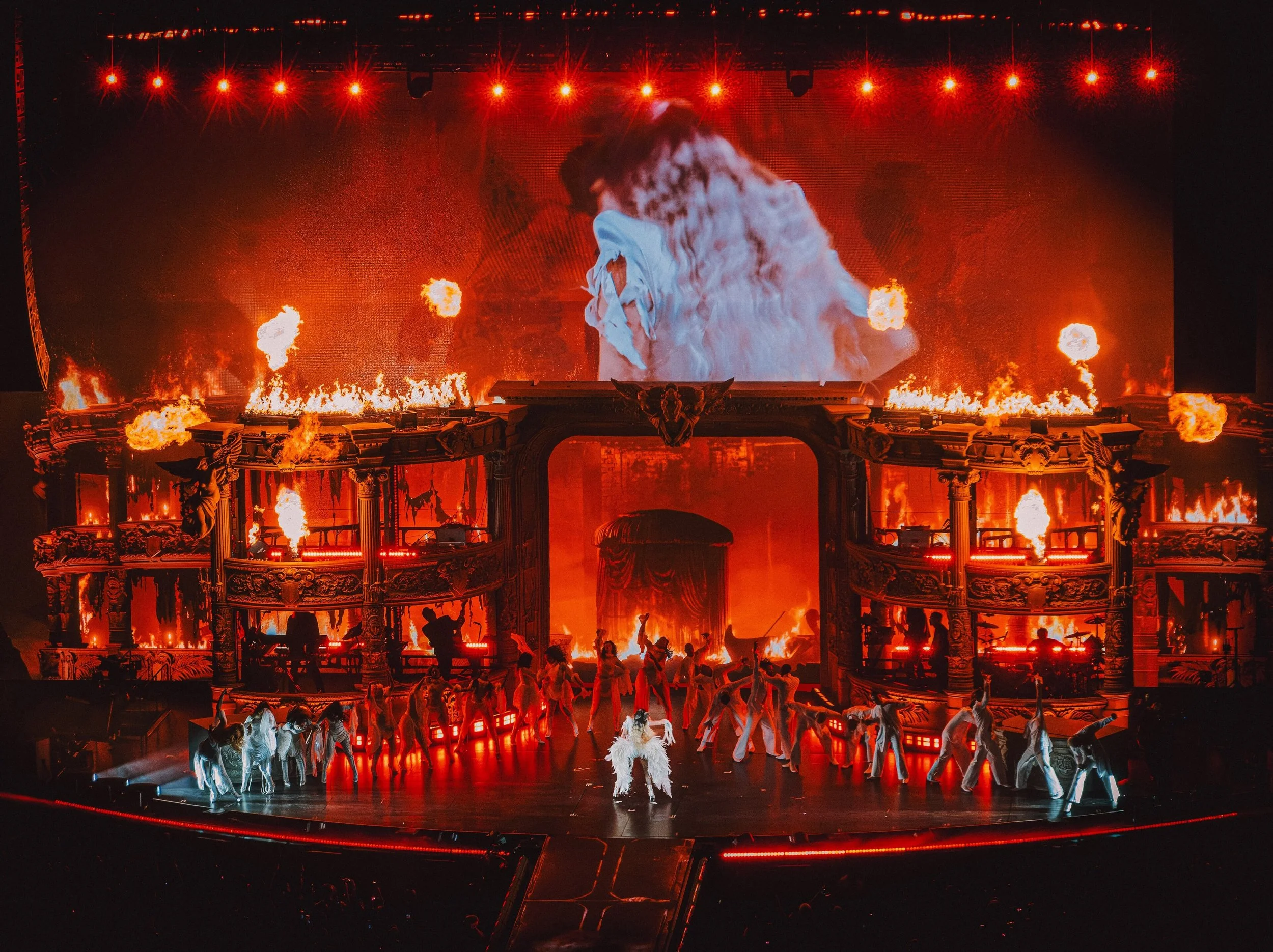
Lady Gaga’s The Mayhem Ball; production and stage design by Jason Ardizzone-West & Es Devlin
This represents one of the defining characteristics of contemporary scenic worldbuilding. Traditional scenic design often illustrates a story that already exists. Narrative architecture creates the spatial conditions through which stories can unfold. Material, proportion, light, movement, and atmosphere become narrative devices equal in importance to dialogue, choreography, or music. As architecture becomes increasingly performative, the distinction between building and stage begins to dissolve.
The Performance Lives Twice
A generation ago, stage environments were designed almost exclusively for the people physically present inside the venue. Today, every audience member arrives carrying a high-resolution camera connected to a global publishing platform. This simple technological shift has fundamentally changed the lifespan of physical experience.
The most successful performances are no longer confined to a single evening. They continue to circulate through photographs, short-form video, design publications, and social media long after the lights come down. For many people, these images become their primary encounter with the work itself.
Great architects have always thought about how buildings would be experienced through images—Julius Shulman’s photographs arguably shaped the legacy of mid-century modernism as much as the buildings themselves. The difference today is that every visitor is also the photographer, and every performance generates thousands of perspectives in real time. Scenic worldbuilding isn’t responding to social media so much as recognizing that documentation has become another dimension of the experience itself.
We often return to a simple observation: far more people will experience a physical environment through images than will ever stand inside it. Designing for documentation is therefore not separate from designing for experience. It is part of the same process. This isn’t about designing “Instagrammable” moments. It’s about recognizing that physical experiences now exist in two forms: first as lived environments, then as shared cultural artifacts. Every photograph extends the reach of the work beyond its physical footprint, allowing architecture to travel through media long after the performance has ended.
For designers, this changes the definition of success. A memorable environment must reward both presence and documentation. It should feel immersive from within while producing images that communicate its essential idea instantly. The strongest examples accomplish both simultaneously because they begin with a singular spatial concept rather than an accumulation of visual effects. The goal is not simply to create spaces that photograph well, but to create spaces that produce photographs that could not have been taken anywhere else.
Worldbuilding as Design Methodology
These productions point toward something larger than a stylistic trend. They suggest that audiences are increasingly responding to environments that feel complete—places with their own atmosphere, logic, and identity rather than collections of impressive individual moments. Whether built from monumental forms, rugged landscapes, or theatrical architecture, the most memorable stages succeed because every element contributes to the same spatial story.
People no longer experience architecture in isolation. They move fluidly between concerts, museums, hotels, workplaces, restaurants, retail environments, and public spaces, carrying expectations from one experience into the next. They may not consciously compare a concert stage to a hotel lobby or a public artwork to a flagship store, but they recognize when a place feels cohesive, intentional, and emotionally resonant.
For designers, that shifts the conversation away from asking what should happen here? toward asking what kind of world are we creating? That question changes the role of architecture. Instead of serving as a container for experiences, it becomes the medium through which those experiences are expressed. Materials, lighting, sound, landscape, and interaction stop behaving like individual design disciplines and begin working together as parts of a single environment.
Ultimately, that may be the lasting contribution of contemporary scenic design. The stage is reminding us that the most memorable spaces are not defined by the amount of technology they contain, but by the clarity of the world they create. As those ideas continue to migrate into public art, hospitality, workplaces, museums, retail, and civic projects, they point toward a future where immersive design is less about adding spectacle and more about creating places people genuinely believe in—even if only for a few hours.