
Site as Medium: Revealing the Latent Qualities of Place
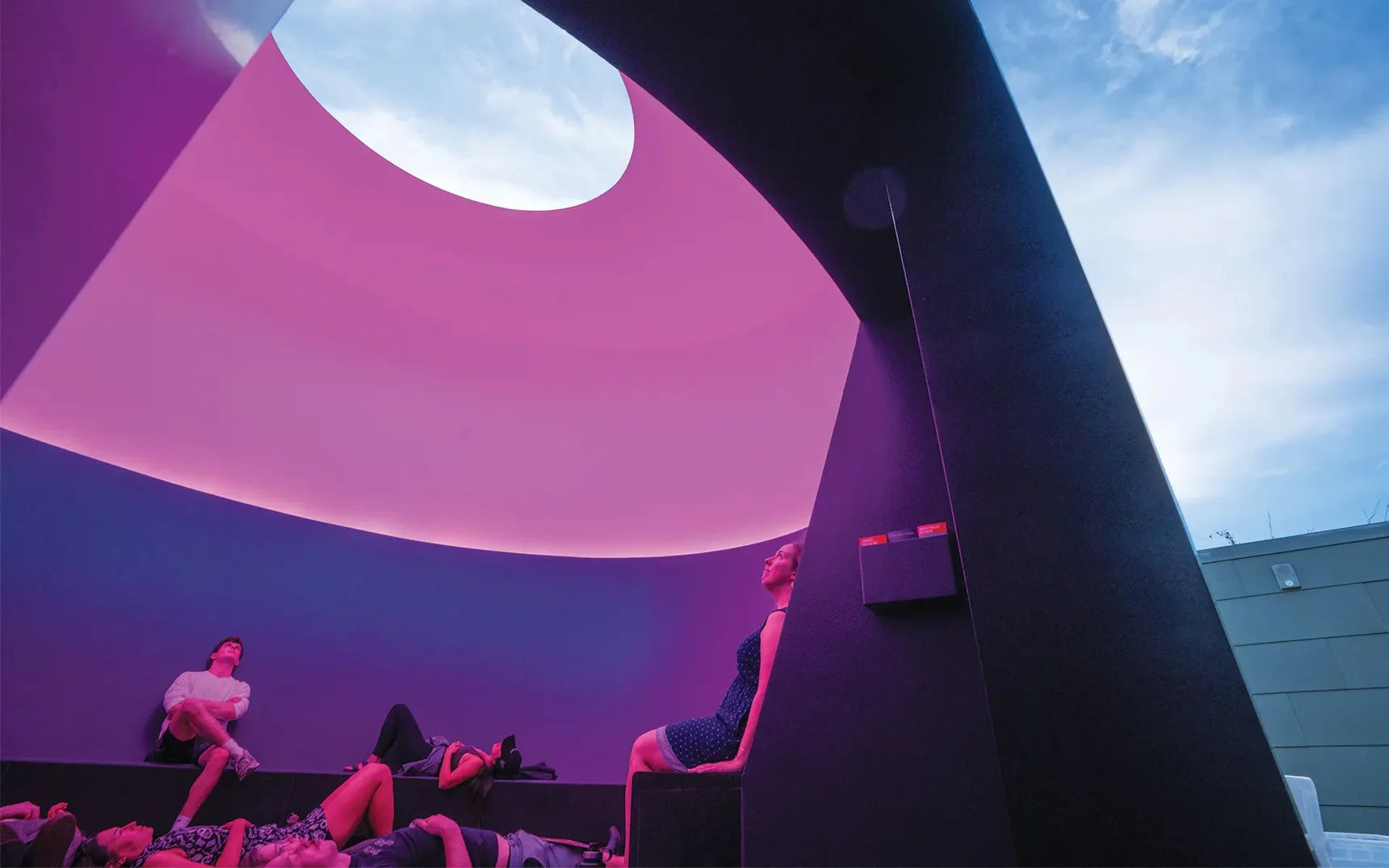
James Turrell’s Skyspace
Most environments today are over-designed and under-considered.
Cities are filled with interchangeable activations, generic placemaking gestures, LED spectacle for spectacle’s sake, and public art that could be relocated to almost any site without losing meaning. The result is work that performs visually but fails contextually. It occupies space without deepening our relationship to it.
We approach site-specific art and interactive spatial design differently. We see the built environment not as a backdrop for content, but as an active participant in meaning-making.
The site is not a container.
The site is the medium.
That distinction changes everything. The most enduring spatial experiences are not driven by novelty alone. They emerge from relationships: between architecture and atmosphere, material and light, body and movement, permanence and participation. Design becomes less about object-making and more about constructing perceptual conditions.
As designer and theorist Paul Rand argued, meaning emerges through relationships rather than isolated forms. Visual communication is fundamentally about “fitting together” disparate elements into coherent experience. That idea extends far beyond graphic design. In spatial practice, architecture, media, sculpture, sound, circulation, and interaction become part of one integrated perceptual system.
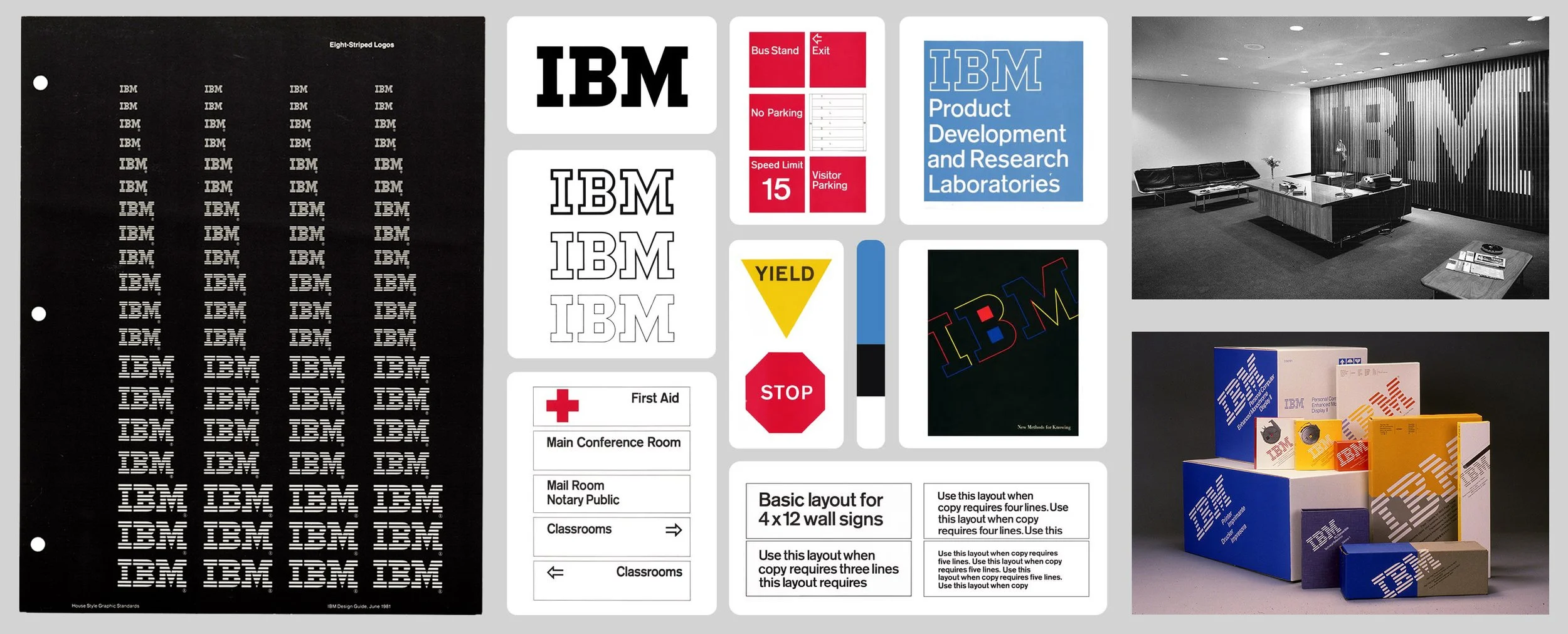
Paul Rand’s 1956 IBM brand system transformed graphic identity into spatial identity using color, graphics, & repetition to create a unified environmental experience.
This is increasingly relevant as physical environments compete with digital ones for attention and emotional resonance.
A successful immersive environment does not simply display information or entertain an audience. It calibrates perception. It changes how people orient themselves within space. It creates awareness of scale, rhythm, texture, light, proximity, and collective presence. The audience becomes conscious not just of the installation, but of themselves moving through it.
That shift from passive viewing to embodied participation is central to our practice.
Beyond Object-Making
Traditional public art often prioritizes the singular object: a sculpture in a plaza, a mural on a wall, a feature piece in an atrium. While those approaches still have value, contemporary spatial practice increasingly requires systems thinking.
The most compelling environments operate across multiple layers simultaneously:
Material behavior
Spatial sequencing
Environmental lighting
Interaction and responsiveness
Graphic language
Acoustic atmosphere
Public circulation
Digital augmentation
Social behavior
None of these elements operate independently. Like color, perception changes depending on surrounding conditions. Rand described color as inseparable from its environment: light, texture, reflection, proportion, and psychological context all alter how it is experienced. Spatial design operates the same way.
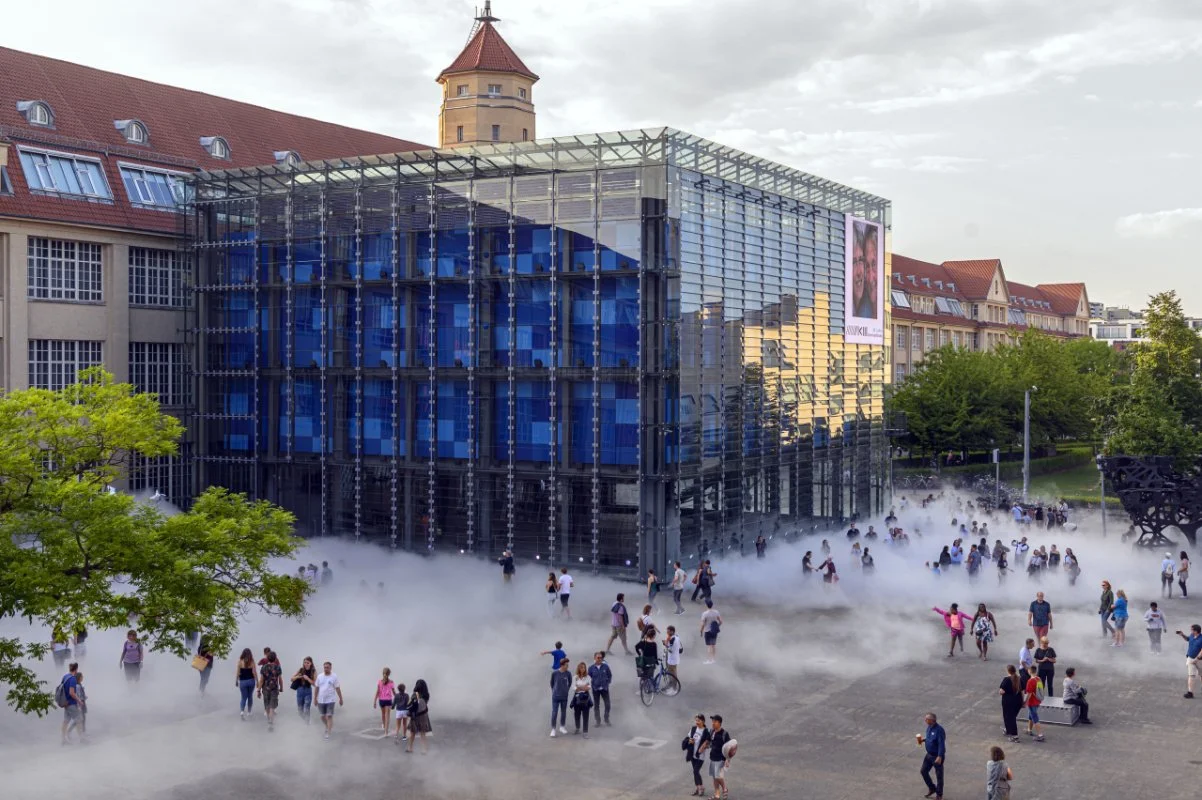
Fujiko Nakaya’s Cloud Walk at Zentrum für Kunst und Medien
An installation is never experienced in isolation. It is experienced through weather, crowd density, sound bleed, architecture, pacing, anticipation, memory, and cultural association.
This is why site specificity matters.
Not as an aesthetic constraint, but as a conceptual framework.
Interactive Design as Environmental Choreography
Interactivity is often misunderstood as technological responsiveness alone. Motion sensors. Reactive lighting. Touchscreens. Data visualization.
But meaningful interaction starts earlier than technology.
A narrow passage that suddenly expands into volume is interactive.
A reflective material that shifts with daylight is interactive.
A sculpture that changes perception depending on vantage point is interactive.
A public space that encourages gathering instead of transit is interactive.
Technology can amplify these conditions, but it should not substitute for them. We think about immersive environments as choreographies of attention. Every decision influences how people move, pause, orient, gather, and remember. The work becomes less about producing static form and more about shaping behavioral possibility.
This approach aligns more closely with architecture, theater, exhibition design, urbanism, and systems design than with conventional object-based art practice.
The outcome is not simply something to look at. It is something to move through, negotiate, and participate within.
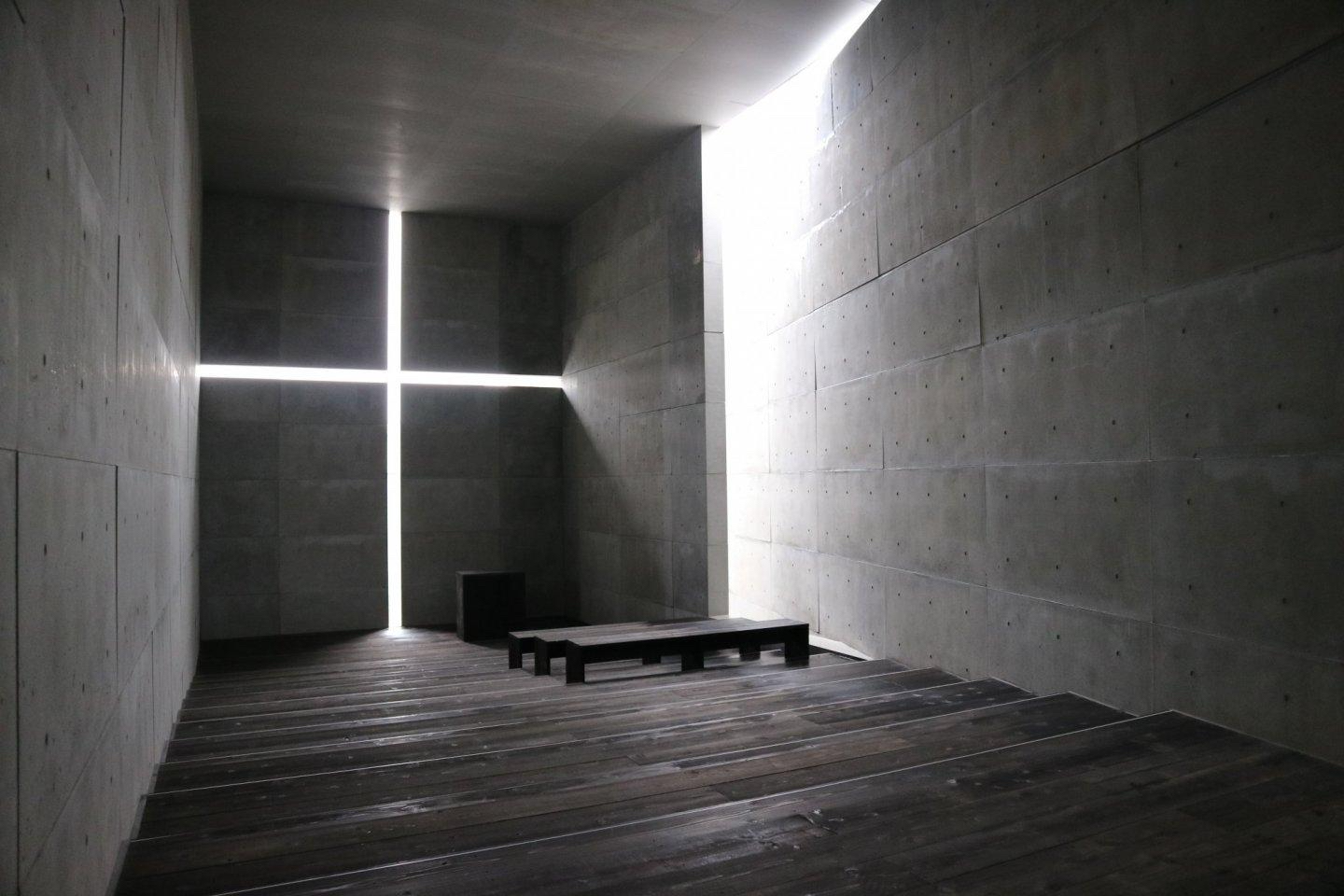
Tadao Ando’s The Church of Light, 1989
The Role of Restraint
Immersive work does not require maximalism.
One of the persistent misconceptions around experiential design is that intensity equals impact. In reality, the most sophisticated environments often rely on restraint, coherence, and precision.
A single material gesture, repeated intelligently across scales, can produce stronger identity than visual overload. A controlled lighting condition can create more emotional resonance than a wall of screens. A subtle environmental shift can become more memorable than spectacle.
The goal is not sensory saturation. It is perceptual alignment.
When spatial, visual, and interactive systems reinforce one another, environments gain legibility. They feel intentional. Coherent. Inevitable.
The audience may not consciously identify why a space feels compelling, but they feel the difference immediately.
Art, Infrastructure, and Public Experience
Increasingly, the boundary between infrastructure and cultural experience is dissolving.
Transit hubs become civic stages. Workplaces become social ecosystems. Retail becomes narrative environment. Public plazas become responsive media landscapes. Hospitality environments become immersive storytelling platforms.
This shift demands a new hybrid practice capable of moving fluidly between art, architecture, technology, and systems design.
That is where we position IMO. Our work exists at the intersection of:
Site-responsive public art
Interactive media environments
Architectural integration
Spatial storytelling
Material experimentation
Behavioral design
Civic engagement
We are interested in experiences that are not merely installed, but inseparable from architecture. Experiences that could not simply be picked up and relocated elsewhere without losing meaning. Because ultimately, the most powerful immersive environments do not impose themselves onto a site.
They reveal something within it.