
Beyond Symbolism: When Public Values Become Spatial Experience
Walk into most civic buildings and their intentions are immediately apparent. Courthouses communicate authority through monumentality. Libraries express openness through transparency. Museums organize knowledge into galleries, while memorials preserve history through permanence and symbolism. These places are designed to represent public values, yet many still position visitors as observers standing outside the ideas they are meant to understand.
The most memorable civic spaces operate differently. Rather than asking visitors to read, interpret, or admire, they invite them to participate. Material, movement, light, sound, and sequence become more than architectural decisions; they become the language through which ideas are experienced. In these environments, democracy is not simply discussed, remembrance is not confined to a plaque, and history is not reduced to a timeline. The architecture itself becomes the lesson.
We believe this distinction marks an important evolution in civic design. The question is no longer How do we represent a public value? Instead, it is How do we allow someone to experience it? When experience becomes the conceptual foundation rather than a layer added afterward, civic space transforms from physical infrastructure into cultural infrastructure.
Beyond Symbolism
Symbols remain important. They condense complex ideas into recognizable forms and help establish a shared identity. Yet symbols alone rarely create lasting emotional understanding because they communicate at a distance. We see them, recognize them, and move on.
Experience closes that distance. It asks visitors to invest their bodies as well as their attention. The pace at which someone walks, the direction they move, what they hear beneath their feet, and how a material changes around them all contribute to meaning. Rather than delivering a message, experiential civic spaces create conditions where meaning emerges through participation.
This shift is particularly significant in public environments because civic architecture serves an extraordinarily diverse audience. Unlike commercial spaces designed around a customer profile, civic places belong to everyone. They must accommodate different generations, backgrounds, political perspectives, and lived experiences while creating opportunities for shared understanding. Experience becomes one of the few design tools capable of bridging those differences because it operates before interpretation. Every visitor may leave with a different conclusion, but they begin with the same physical journey.
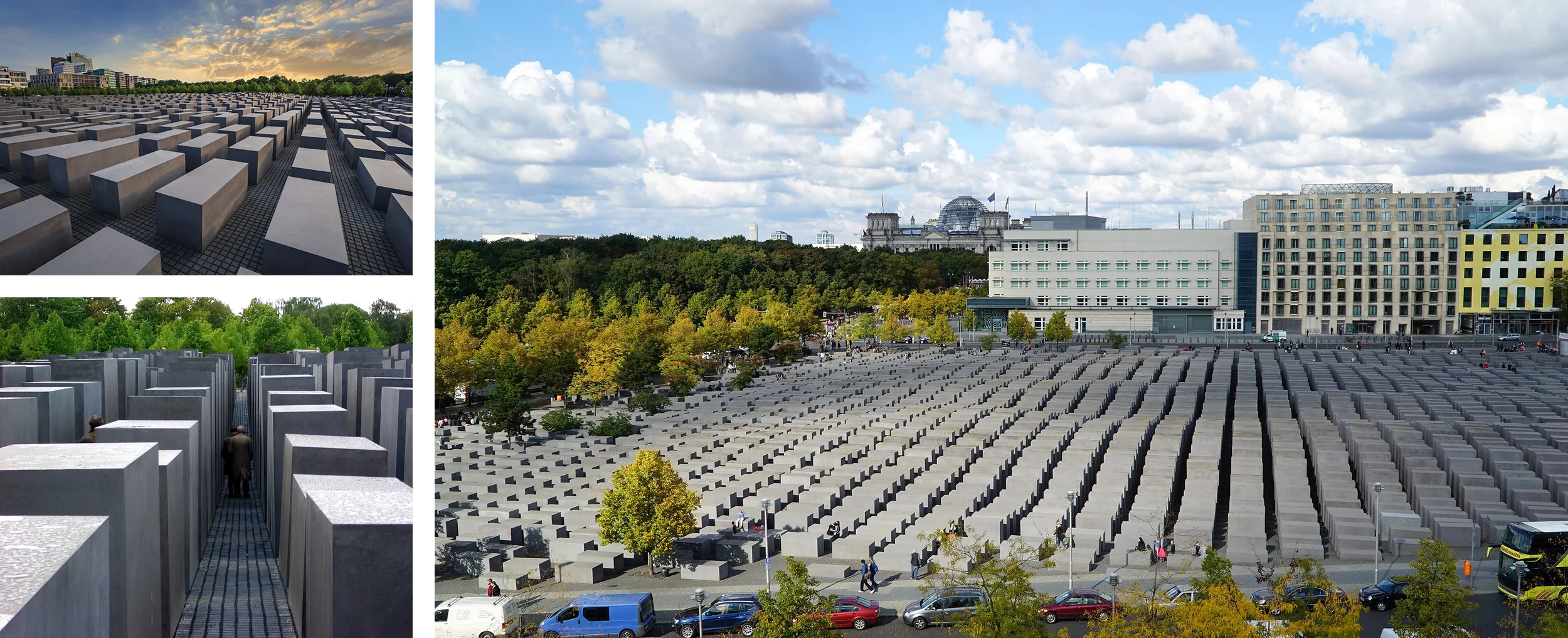
One of the clearest demonstrations of this shift is the Memorial to the Murdered Jews of Europe by Peter Eisenman. Composed of 2,711 concrete stelae arranged across an undulating field, the memorial offers almost no explicit explanation of what visitors should think or feel. Instead, meaning emerges through movement. As people wander deeper into the grid, the ground gradually falls away while the monoliths rise overhead, compressing sightlines, altering acoustics, and producing an increasing sense of isolation and disorientation. There is no singular route through the memorial and no prescribed interpretation. Visitors construct their own experience through their bodies
Material Is Never Just Material
Material is often discussed in terms of durability, maintenance, or appearance, but some of the most powerful civic projects demonstrate that material also carries conceptual weight. Steel can weather alongside history. Glass can embody openness. Concrete can amplify silence. Material is not simply what a project is made from; it shapes how a project behaves and, in turn, how it is understood.
Few contemporary memorials illustrate this more powerfully than the National Memorial for Peace and Justice designed by Equal Justice Initiative (EJI) in partnership with architecture firm MASS Design Group.
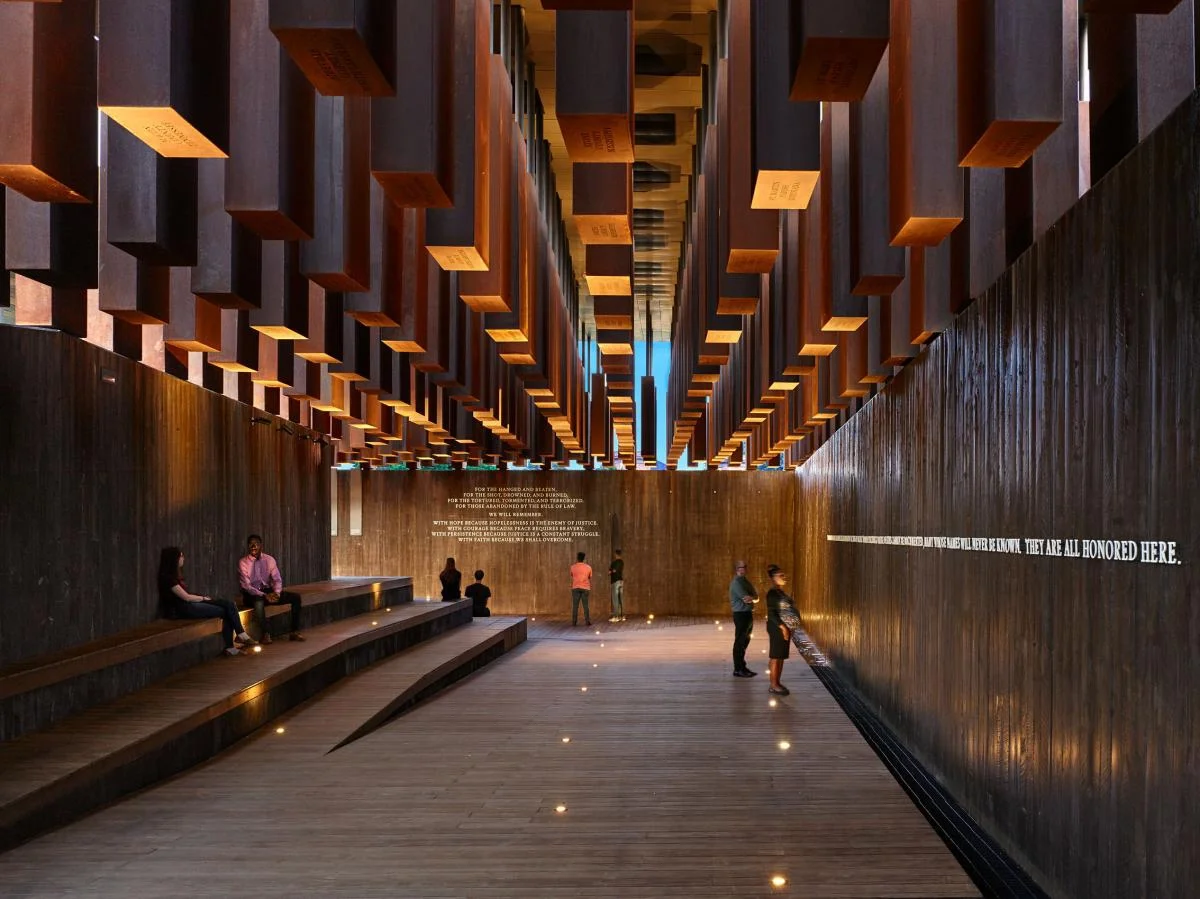
The memorial consists of hundreds of suspended weathering steel monuments, each representing a county where documented racial terror lynchings occurred. Visitors begin their journey walking among these forms at eye level, but as the site gradually descends, the monuments remain fixed overhead until they hang above the body. Nothing about the steel changes during this movement, yet the emotional reading of the space transforms entirely. The visitor experiences a gradual shift from observation to vulnerability, understanding history not through illustration but through changing bodily relationships with scale, gravity, and material.
The memorial demonstrates a principle that extends far beyond commemorative design: meaning often emerges through spatial relationships rather than symbolic representation. Material becomes inseparable from choreography.
Buildings Can Tell Stories Before Exhibits Do
If material establishes emotional conditions, sequence establishes narrative. Every building guides people through space, but only a handful use circulation itself as a storytelling device.
The National Museum of African American History and Culture was led by three prominent Black architects—Max Bond, Phil Freelon, and Sir David Adjaye—offers one of the clearest examples of architecture functioning as narrative rather than container. A bottom-to-top organizational strategy known as “The Ascent” takes visitors deep underground before gradually bringing them back into the light. Before encountering the museum’s exhibitions, visitors descend by elevator (which feels like a time machine) into the deepest historical galleries, beginning with the arrival of enslaved Africans and progressing through emancipation, segregation, civil rights, and contemporary American history. Only after this journey do they arrive at galleries celebrating Black creativity, innovation, and cultural achievement.
The interior architecture of the museum is inseparable from its message. The visitor’s vertical movement mirrors historical progression, making chronology something that is physically experienced rather than intellectually assembled. By the time the collections are encountered, the space has already established an emotional framework for understanding them. Story is communicated through sequence long before it appears on a gallery wall.
This distinction is increasingly relevant to experiential design. Narrative does not require screens, projections, or interactive technology. Sometimes the most effective storytelling is embedded within circulation itself.
Participation Creates Responsibility
Experiential civic spaces also recognize that participation does not have to be playful to be meaningful. In fact, some of the most profound examples ask visitors to contribute to the emotional atmosphere of a place rather than simply consume it.
Inside the Jewish Museum Berlin, Daniel Libeskind designed a series of architectural voids that represent absence as much as presence. One of those voids contains Shalekhet (Fallen Leaves), an installation composed of more than 10,000 heavy iron faces scattered across the floor. Visitors are encouraged to walk across the work, causing the steel discs to collide beneath each step and fill the chamber with harsh metallic echoes.
The installation is remarkable because the visitor becomes essential to its operation. Without movement, it remains largely silent. With movement, every footstep contributes to an unsettling soundscape that cannot be separated from the act of participation itself. The work resists passive observation by making each visitor aware of their presence within the space. Rather than presenting memory as something to be viewed, it becomes something enacted through the body.
This is an important distinction for civic design. Participation is often discussed as engagement, but engagement alone is not the objective. The deeper ambition is creating moments where visitors recognize themselves as active participants in a collective narrative rather than spectators standing outside it.
Architecture Can Perform Democracy
Perhaps the clearest example of civic values becoming architecture rather than symbolism is the Reichstag Dome by Norman Foster. Following the reunification of Germany, the new intervention did far more than add a public observation deck to the historic parliament building. It reorganized the relationship between citizens and government.
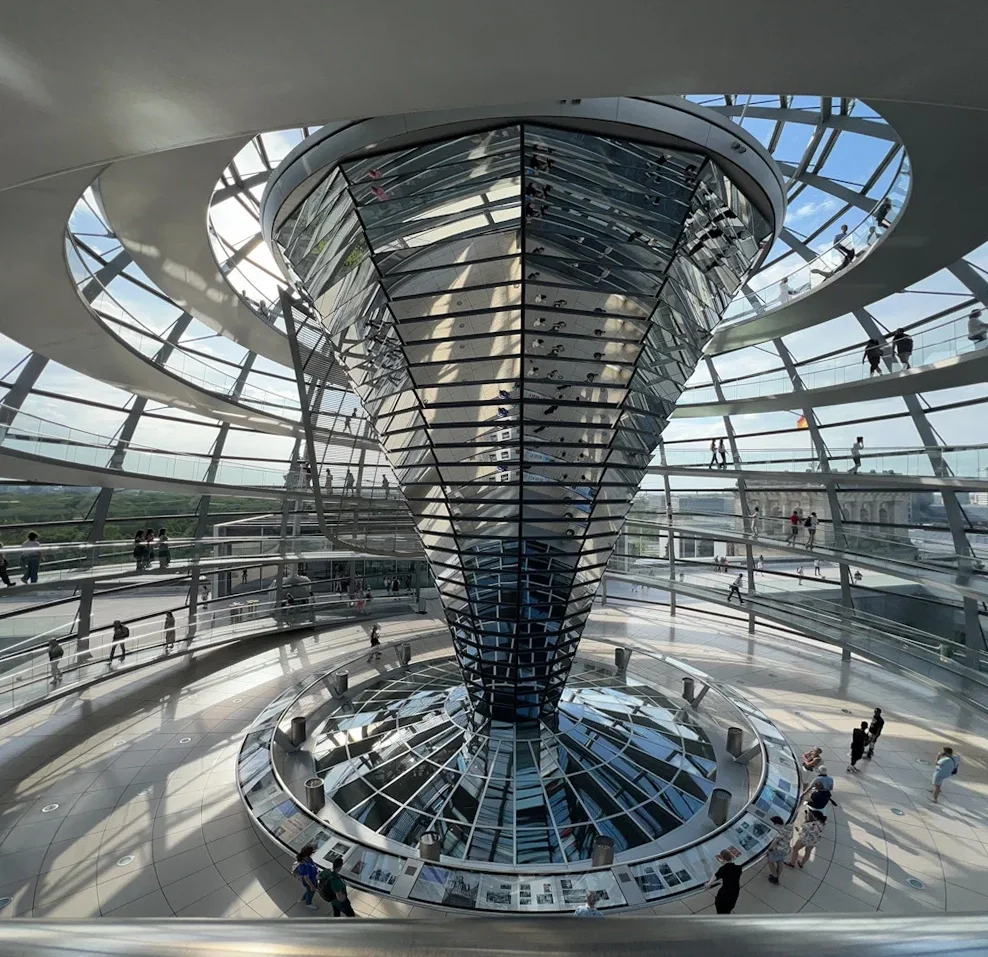
Visitors ascend a gently spiraling path to the top of the glass dome, where they can look down into the parliamentary chamber below. The experience is deceptively simple, yet conceptually profound. Rather than representing transparency through metaphor or inscription, the architecture performs it. Citizens literally occupy a position above their elected representatives while daylight fills the legislative chamber beneath them. The physical arrangement communicates that government remains accountable to the public it serves.
What makes the project so enduring is that transparency is experienced rather than explained. The architecture transforms an abstract democratic principle into a spatial relationship that every visitor can immediately understand.
Designing Civic Experience
Although these projects differ dramatically in program, geography, and historical context, they share a common design philosophy. None depend on spectacle, novelty, or technology to create meaning. Instead, they leverage the fundamental tools of spatial design—material, movement, sequence, sound, proportion, and light—to create experiences that linger long after the visit has ended.
Collectively, they suggest that civic architecture is evolving beyond representation toward participation. Rather than asking buildings to symbolize public values, they ask them to embody those values through experience. This shift has implications not only for memorials and museums but also for libraries, parks, community centers, transportation hubs, and public art. Every civic project has the opportunity to become more than a destination; it can become a shared ritual that strengthens how people understand one another and the places they inhabit.
We see this as one of the most important opportunities facing experiential design today. Civic space should not simply communicate ideas about community, democracy, culture, or memory. It should create environments where those ideas are practiced through movement, participation, and shared experience. When architecture becomes something people actively inhabit rather than merely observe, public space does more than house civic life—it helps cultivate it.