
Designing for Silence: How Sound Shapes Behavior
Modern workplaces and public environments are far louder than most people realize. HVAC systems hum constantly overhead, open-office conversations spill across entire floors, mechanical equipment vibrates through structural frames, and traffic noise seeps through curtain walls and glazing. Sound has quietly become one of the most influential architectural materials in contemporary environments, yet unlike light, form, circulation, or material expression, acoustics are rarely treated as a primary design driver.
Instead, sound is often addressed late in the design process through isolated acoustic treatments or code compliance requirements. The result is a familiar condition across offices, libraries, transit hubs, and cultural spaces: environments that look carefully designed but behave unpredictably once people begin to occupy them.
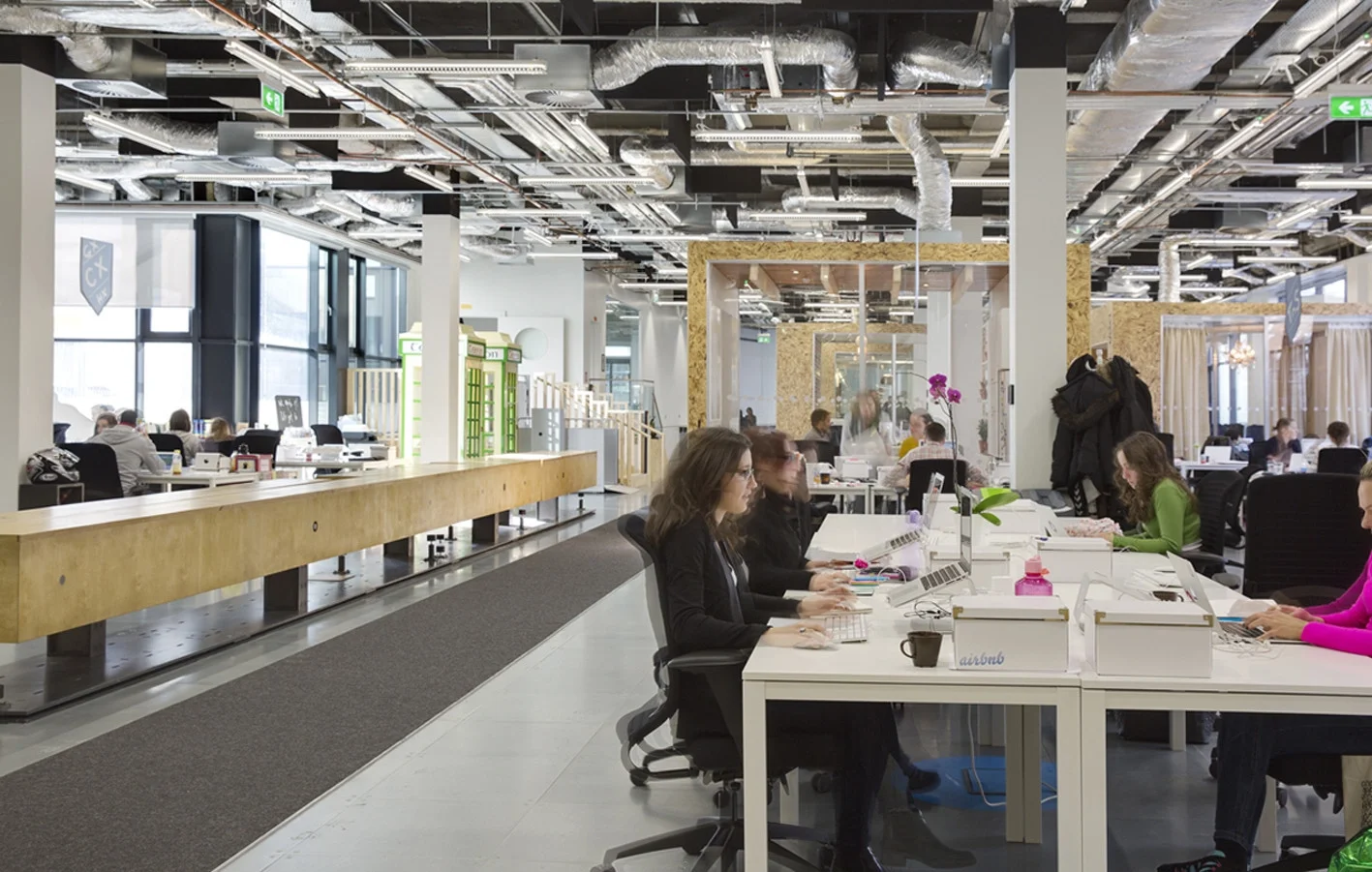
Airbnb’s European Operations Hub in Dublin by Heneghan Peng Architects
More than seventy years ago, acoustic researcher Karl D. Kryter published The Effects of Noise on Man, a foundational study examining how sound influences human behavior, cognition, and health. Although the research predates open offices, hybrid work models, and experience-driven public architecture, its conclusions are strikingly relevant today. Kryter’s work delivers a simple but powerful insight: noise is not a neutral background condition. It is an environmental force that shapes how people think, interact, and move through space.
For designers of contemporary workplaces and civic environments, this means acoustics must be treated not as a technical afterthought but as a behavioral design system.
Noise Is a Behavioral Force, Not Just a Sensory Experience
One of Kryter’s most important findings is that noise affects far more than hearing. Sound directly influences cognitive performance, physiological stress responses, and behavioral efficiency. Across laboratory and real-world studies, increasing noise levels were shown to reduce task accuracy, increase fatigue and error rates, slow reaction times, and elevate stress and physiological arousal.
What makes these findings particularly important for designers is that these effects often occur before people consciously recognize the problem. In many experiments, participants reported that sound levels were acceptable or that they had adapted to the environment, yet objective measurements still showed measurable declines in performance and concentration. The body compensates long before the mind becomes aware of the disruption.
In spatial design, this creates a hidden mismatch between perceived comfort and actual cognitive performance. A workplace may appear productive and collaborative while quietly undermining focus, decision-making, and sustained attention. Acoustic comfort therefore cannot rely solely on occupant feedback or tolerance thresholds. It must be understood as a behavioral design variable, one that influences how environments support concentration, learning, creativity, and recovery.
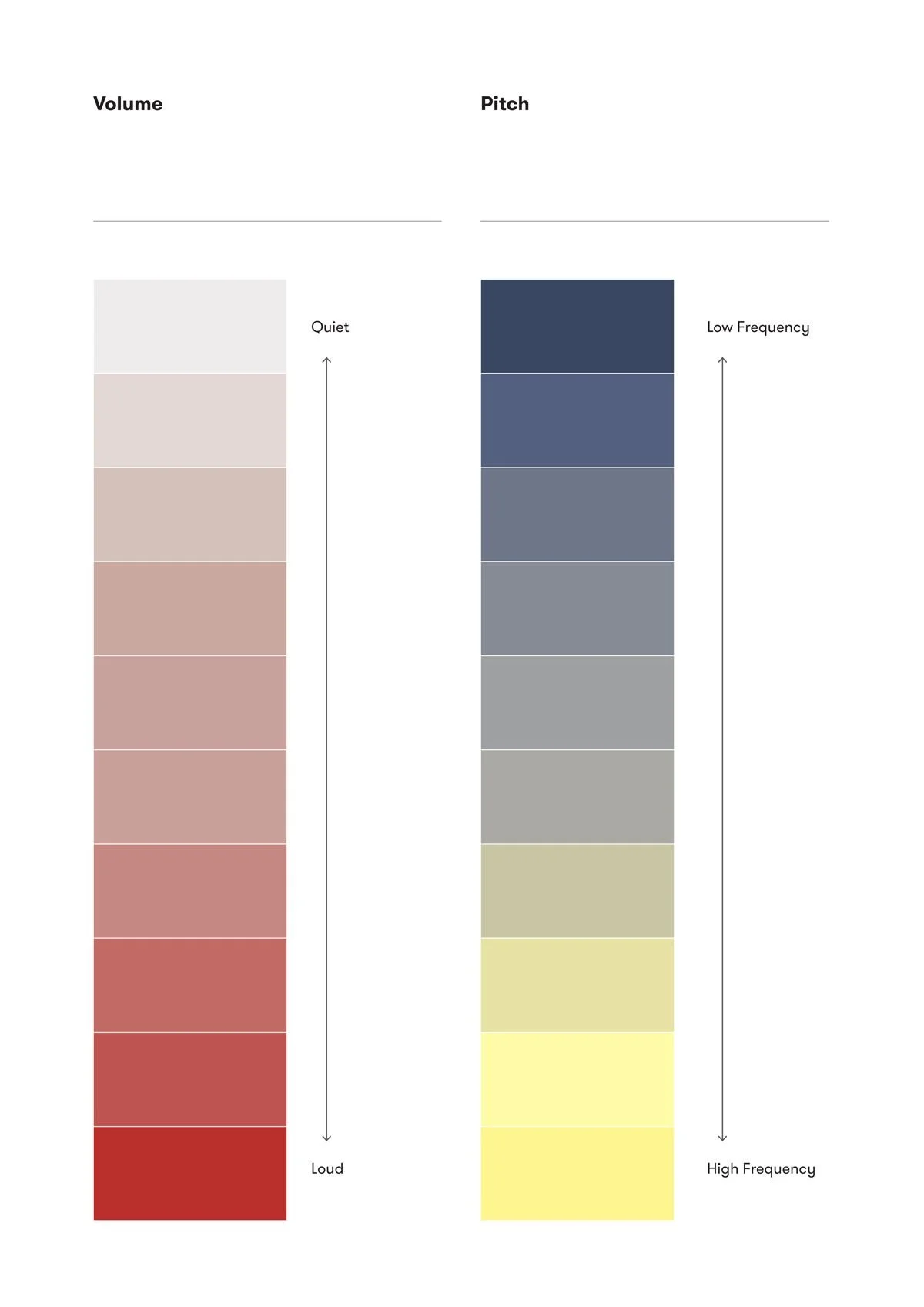
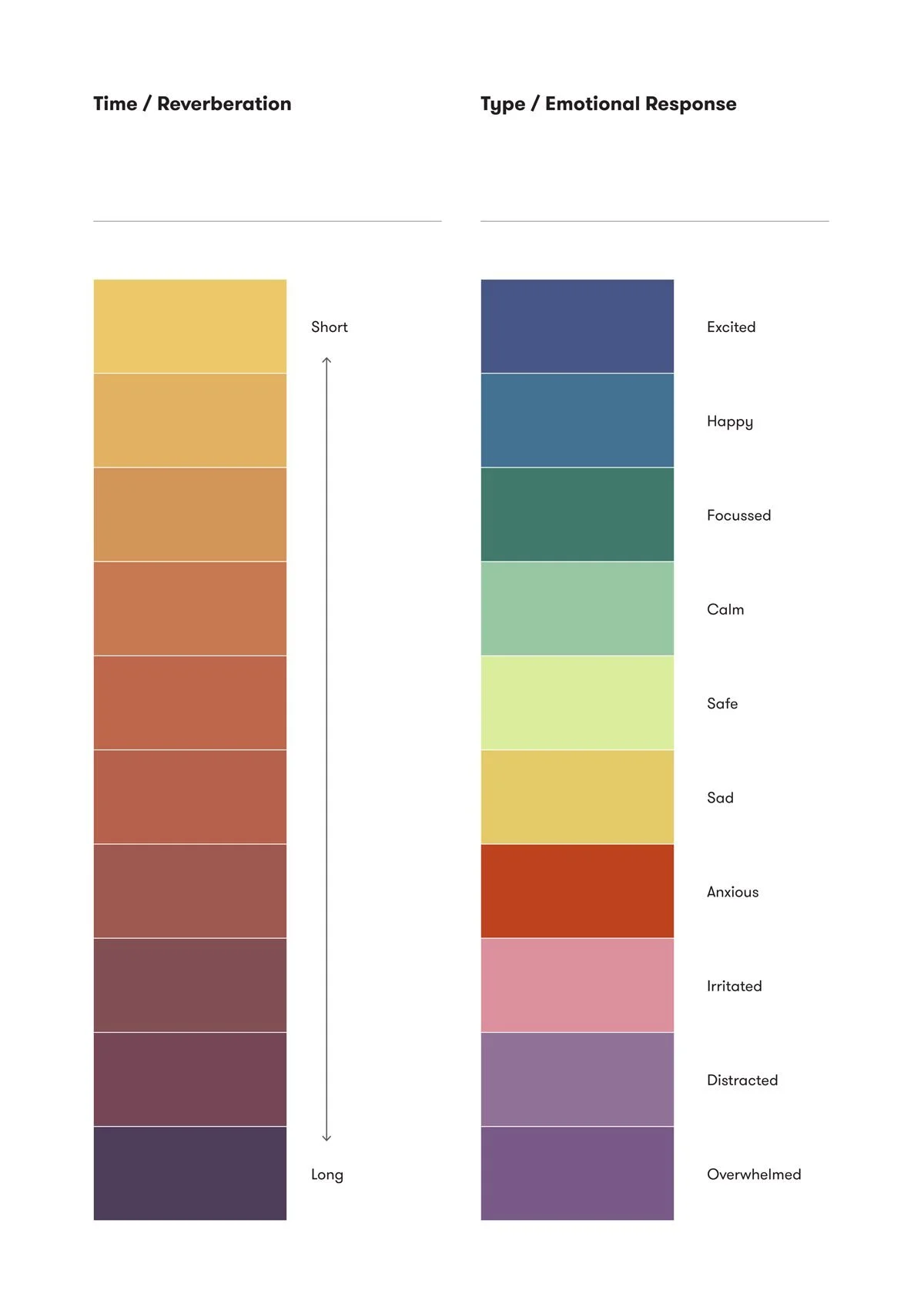
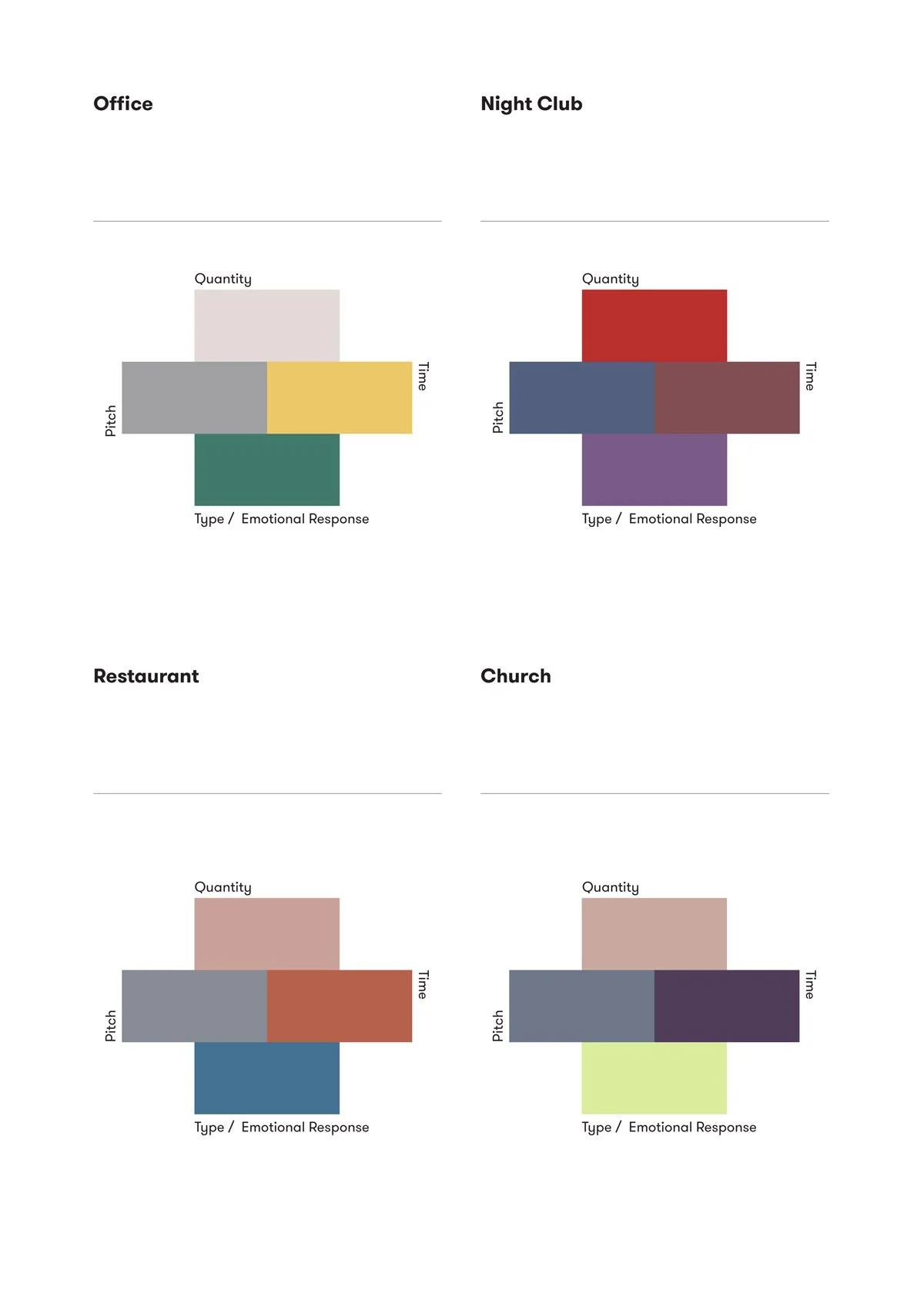
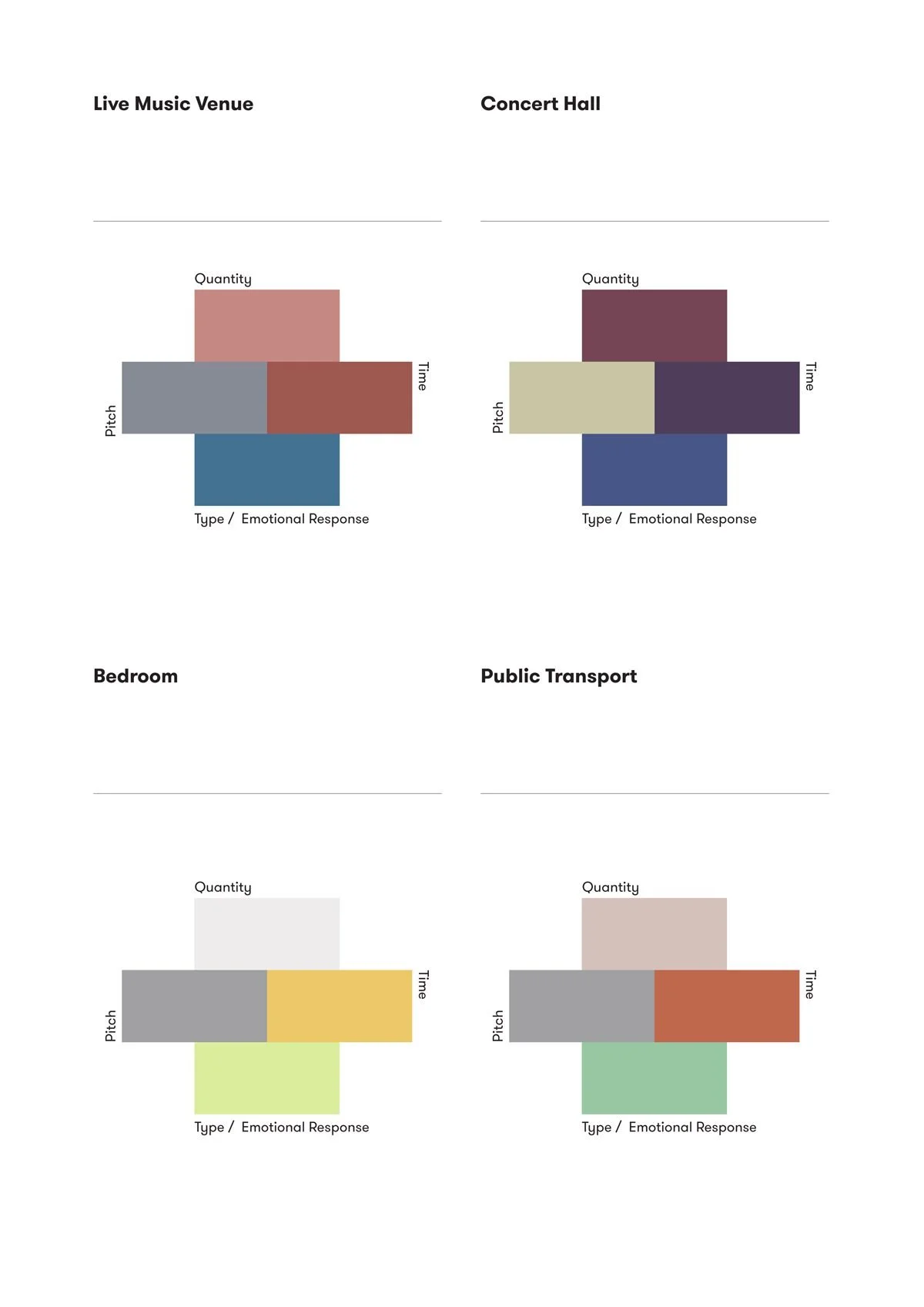
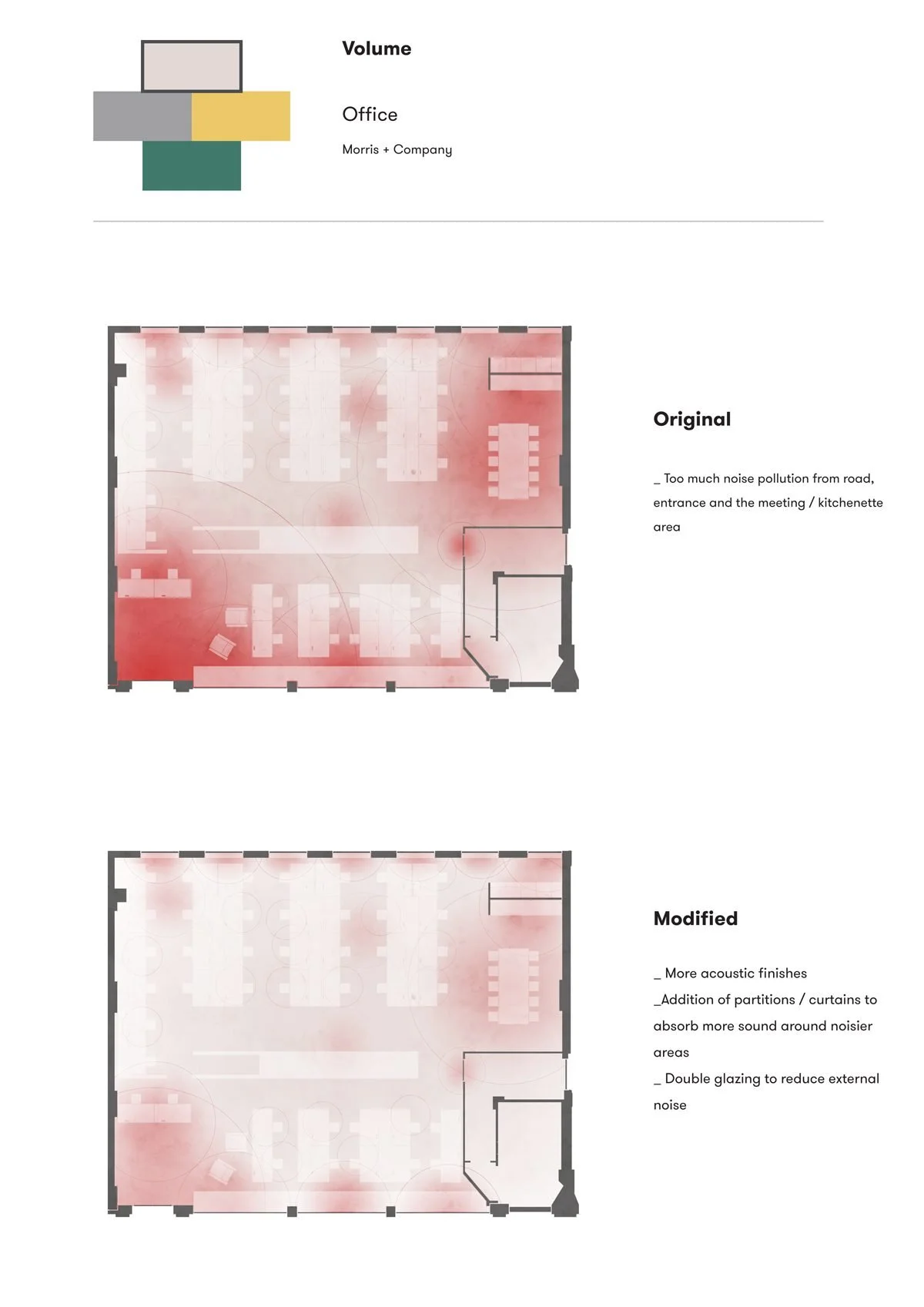
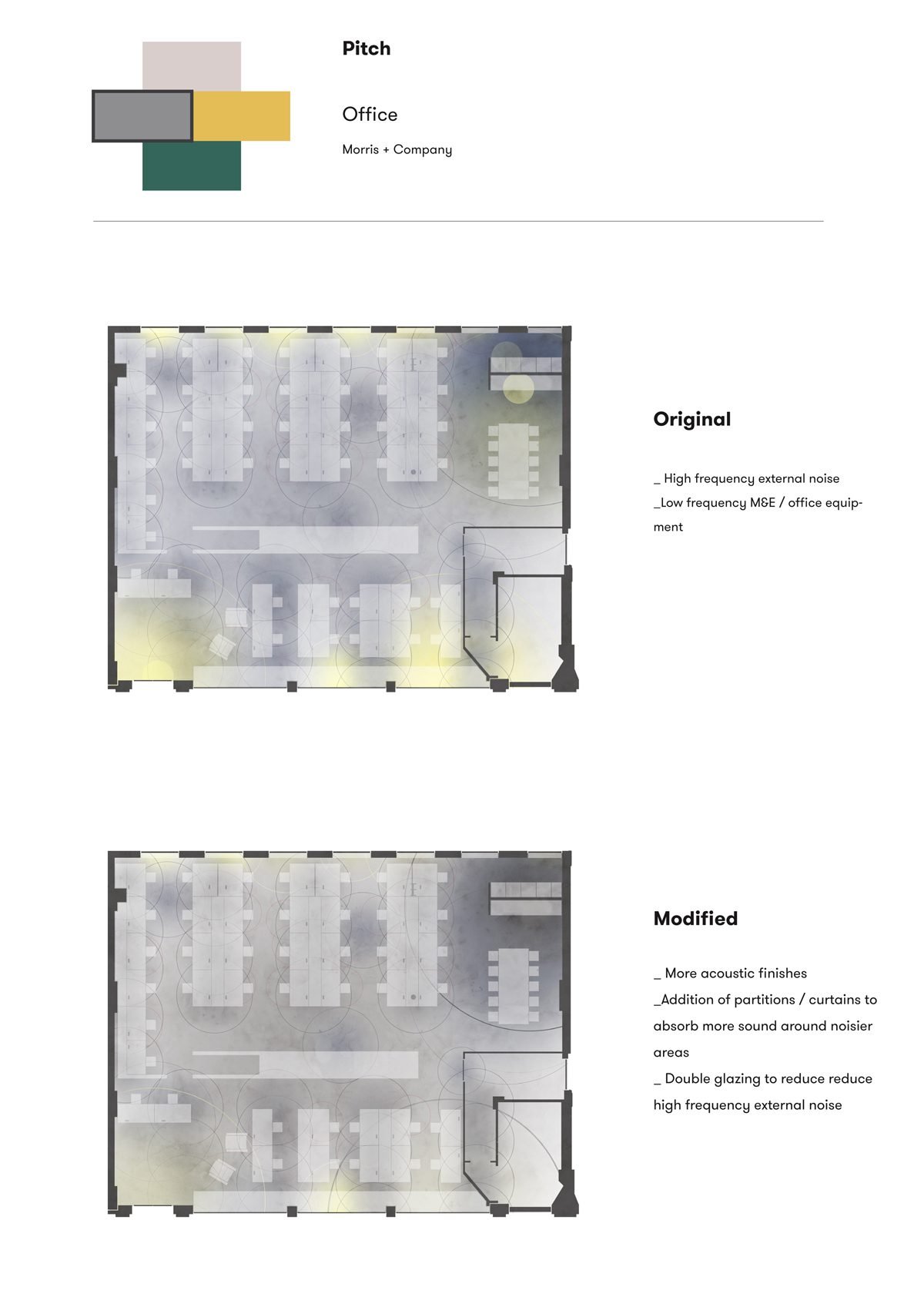
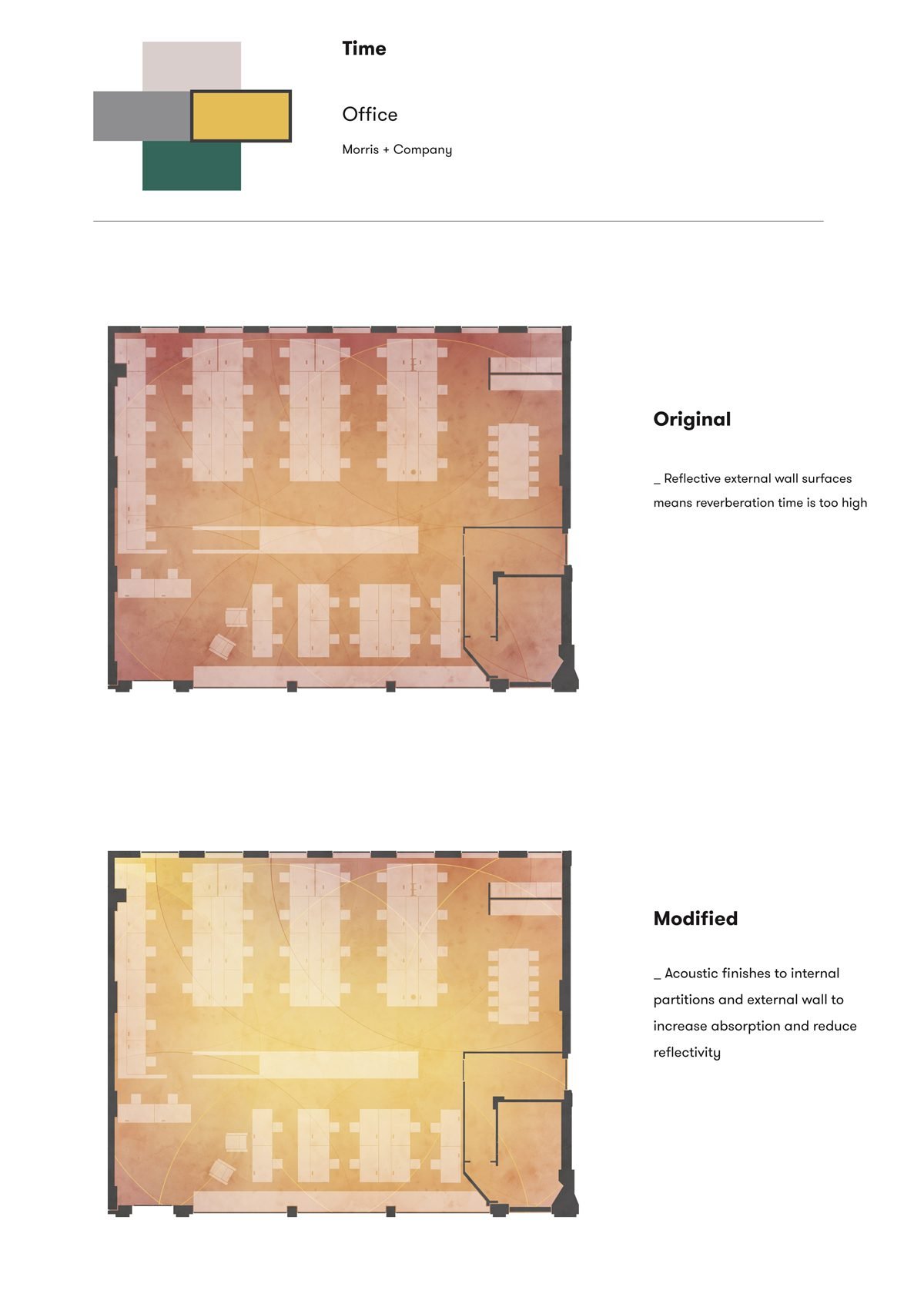
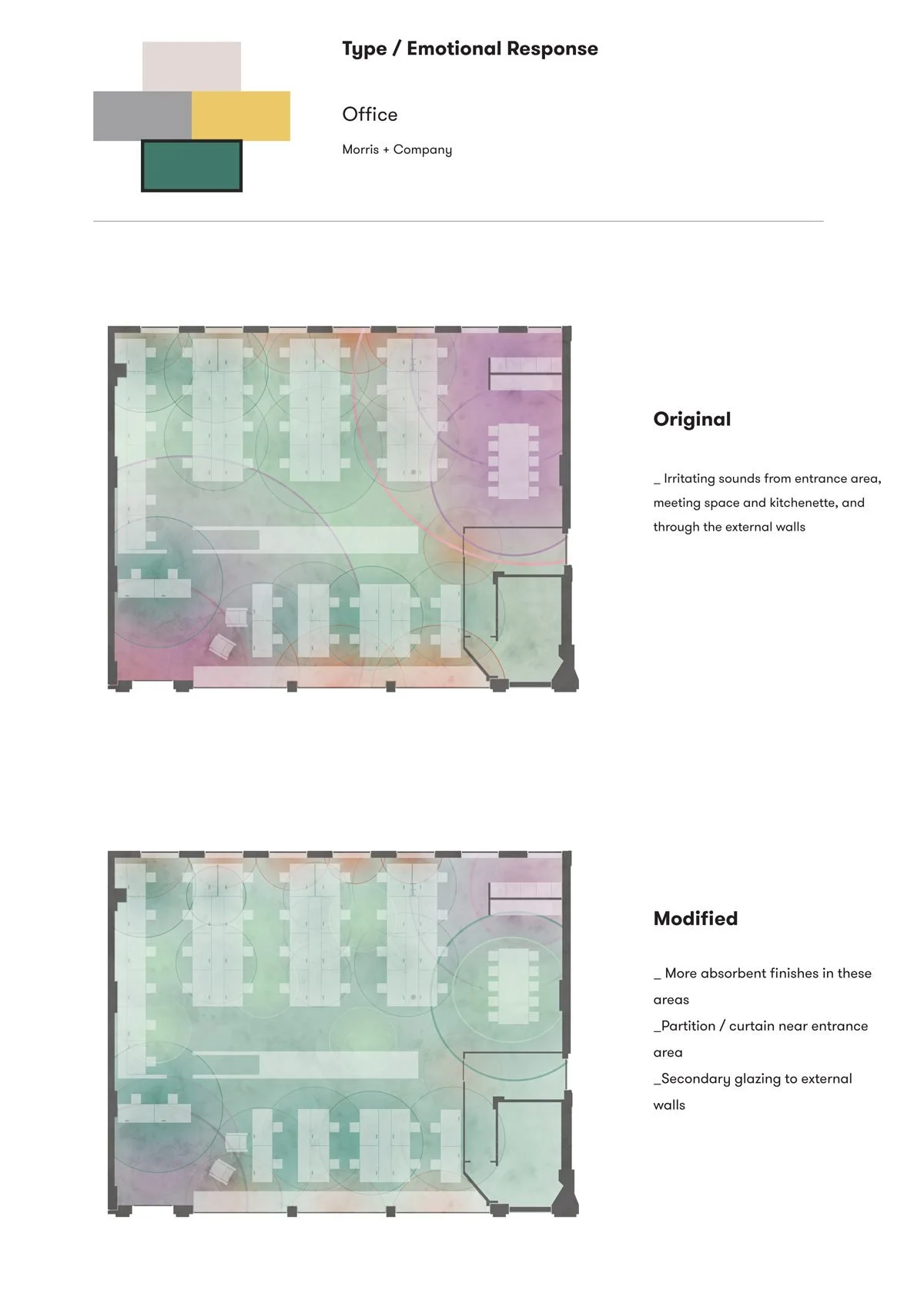
Studioshaw explored acoustics beyond technical metrics by studying how people emotionally respond to sound in different contexts. They translated these responses and measurable sound qualities into a color-based graphic language (above) that visualizes both the acoustic performance of a space and how it feels to experience it.
The Myth of Adaptation in Open Workplaces
One of the most persistent misconceptions in workplace design is that people eventually “get used to” noise. Kryter’s research challenges this assumption directly. While some level of habituation occurs, degradation in cognitive performance often remains, particularly during tasks that require memory, concentration, or analytical reasoning.
This dynamic has become especially visible in open-plan workplaces. Originally introduced to increase collaboration and transparency, open offices frequently produce the opposite outcome when acoustic design is neglected. Workers experience increased cognitive load from unpredictable background conversations, reduced productivity during tasks requiring deep focus, fragmented collaboration caused by constant interruption, and a heavy reliance on headphones as personal noise control.
The widespread use of headphones has effectively turned workers into their own acoustic infrastructure. Employees construct private sound environments in order to reclaim focus that the space itself does not provide. This is not a failure of workers to adapt but evidence that the spatial environment is failing to support multiple modes of attention.
Designing effective workplaces requires a shift away from a single acoustic condition toward graduated sound environments. Spaces should offer a range of acoustic profiles that correspond to different forms of work, including quiet zones for concentration, moderately active areas for collaboration, and social zones where higher noise levels are expected. When quiet must be negotiated socially rather than supported spatially, the environment places unnecessary strain on its occupants. Acoustic choice should be embedded directly into the architecture.
When Speech Becomes Noise
Another key area of Kryter’s research examines how background sound interferes with speech intelligibility. When speech competes with environmental noise, people instinctively increase their vocal volume to remain understood. This phenomenon, known as the Lombard effect, creates a cascading amplification of sound within enclosed environments.
One conversation becomes two raised voices, and two conversations quickly become an ambient layer of speech that spreads across the room. Over time, the entire environment grows louder. In offices and public interiors, this dynamic creates several challenges. Meetings bleed into surrounding work areas, informal conversations become unintentionally public, and sensitive discussions lose privacy even without visual exposure.
Speech is uniquely disruptive because it carries semantic meaning. The human brain is wired to process language automatically, even when we attempt to ignore it. This means overheard conversations are significantly more distracting than non-verbal background noise. Designing environments where speech remains intelligible within small zones while fading quickly beyond them is essential to maintaining both focus and privacy.
Acoustic design, therefore, is not only about comfort. It is closely tied to equity and participation. When speech travels everywhere, people become more guarded and conversations shift from open dialogue to controlled exchanges. Spaces quietly shape behavior in ways that are rarely acknowledged but deeply influential.
Moving Beyond Decibels: Designing Acoustic Systems
Traditional acoustic design often focuses on technical metrics such as decibel reduction, Noise Reduction Coefficient (NRC), reverberation time, and sound transmission ratings. While these measurements are important, they do not fully capture how people experience sound over time within complex environments.
Kryter’s research encourages a broader perspective. Instead of treating sound purely as a quantity to be minimized, designers can approach it as a dynamic environmental condition that interacts with human behavior.
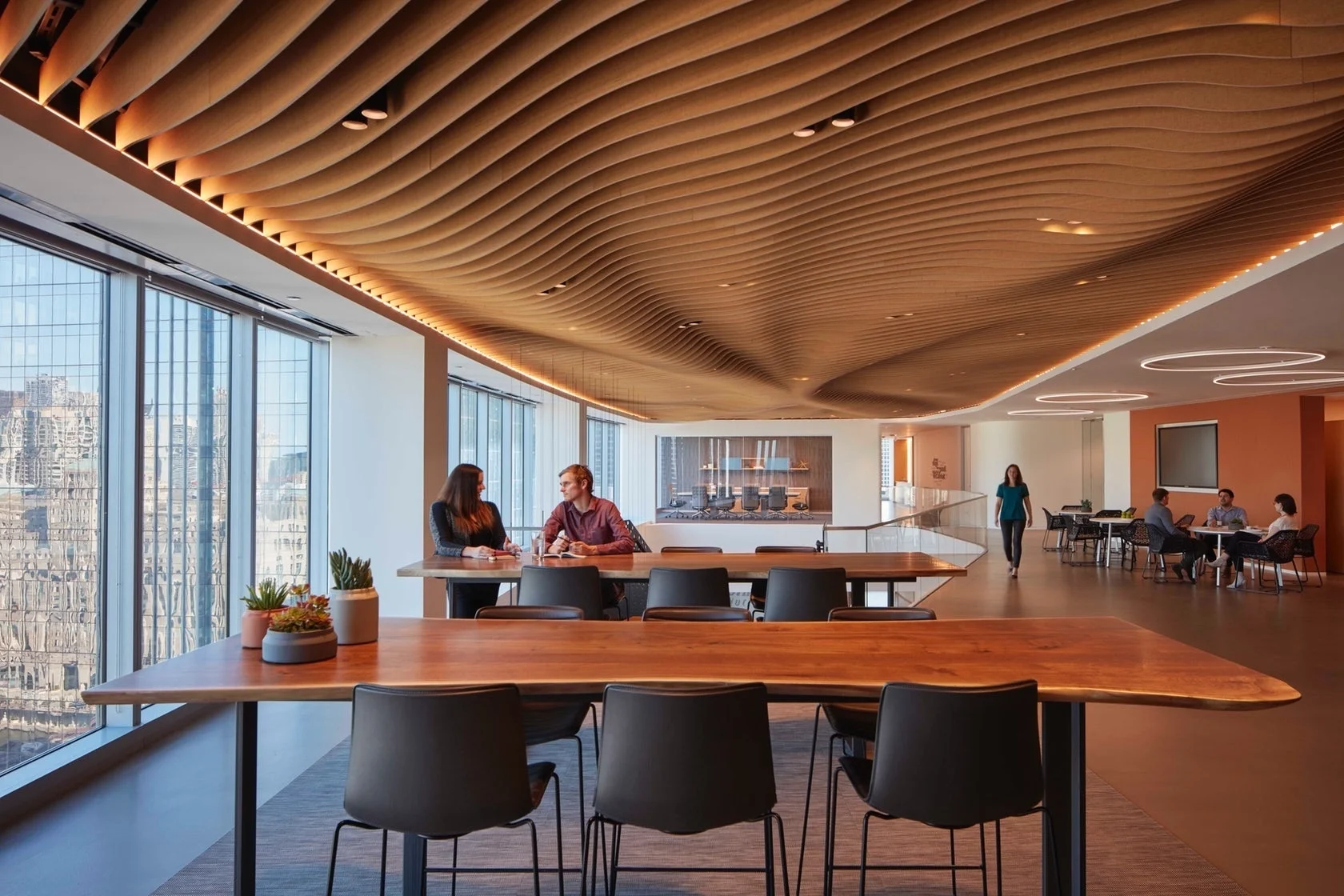
Material selection becomes a primary tool. Surfaces can diffuse, absorb, reflect, or soften sound depending on their geometry, density, and texture. Perforated metals, acoustic textiles, porous composites, and textured finishes can all contribute to controlling sound while maintaining visual richness within the space. The objective is not to eliminate sound entirely but to prevent harsh acoustic reflections while preserving spatial energy.
Equally important is spatial sequencing. Sound levels should rise and fall gradually as people move through an environment, helping occupants intuitively understand how different zones function. Entry areas may tolerate higher ambient noise, circulation spaces can act as acoustic buffers, and work zones benefit from softer reflections and shorter reverberation times. When acoustic transitions mirror spatial transitions, environments become more legible and comfortable to navigate.
Programmatic alignment further strengthens this strategy. Different activities require different acoustic conditions. Focus work demands minimal distraction, collaboration benefits from controlled speech clarity, and social spaces can sustain higher sound levels without discomfort. When acoustic character aligns with behavioral intent, sound becomes an integral part of the architecture’s organizational logic.
Applying Acoustic Thinking Beyond the Workplace
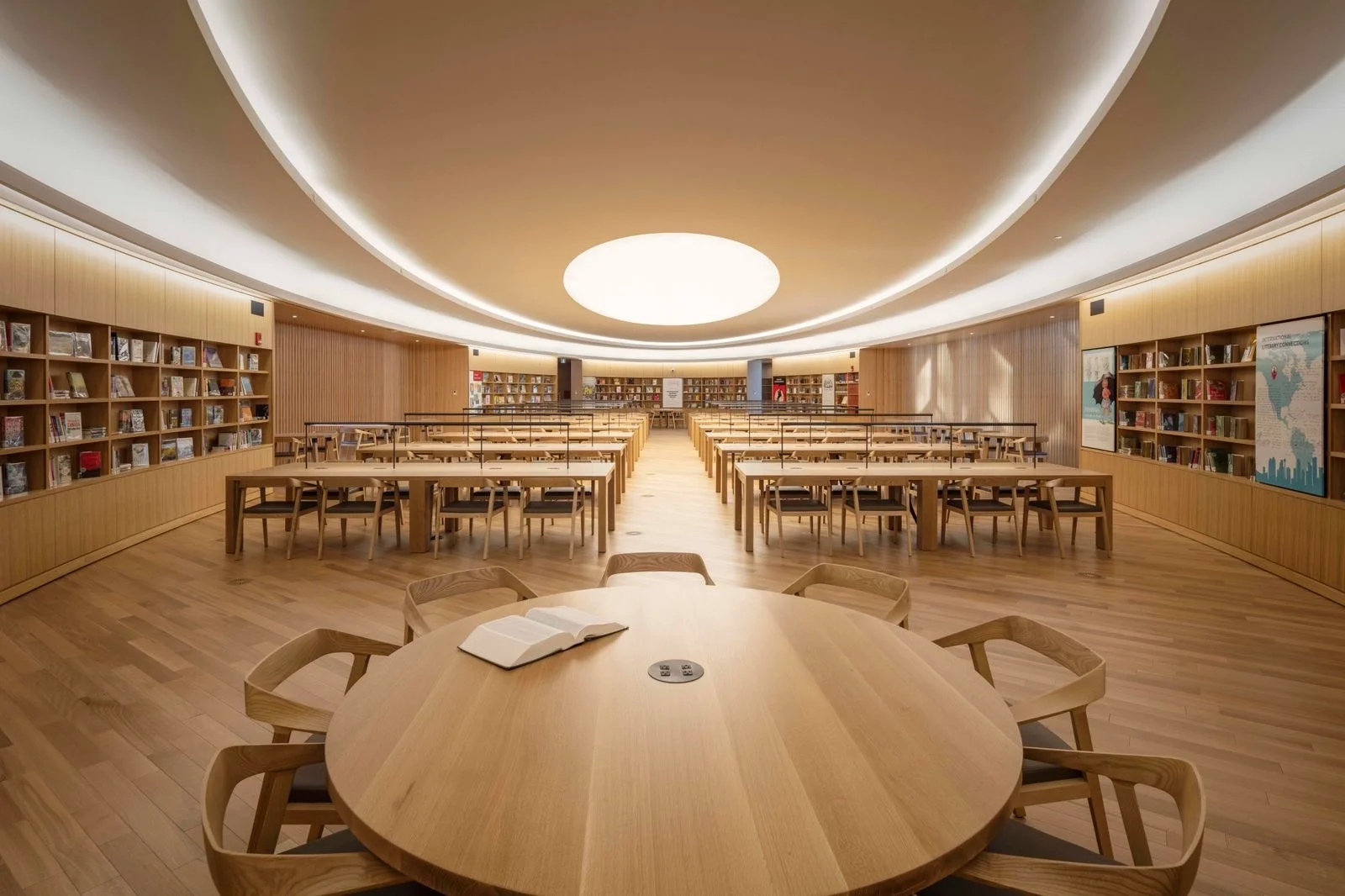
Although workplace environments often highlight acoustic challenges most visibly, Kryter’s insights extend across many forms of public architecture. Libraries and cultural institutions, for example, are increasingly hybrid civic environments that support reading, events, digital access, and community gathering. Rather than enforcing uniform silence, successful libraries create layered acoustic calm that allows multiple activities to coexist.
Transit environments present another opportunity for acoustic design. Stations and terminals frequently suffer from overwhelming reverberation caused by large hard surfaces and mechanical systems. Improving acoustic clarity can significantly reduce cognitive stress for travelers by making navigation easier and announcements more intelligible.
Civic interiors such as museums, government buildings, and cultural venues must also balance openness with dignity and accessibility. Environments that are acoustically overwhelming can discourage participation and conversation. Thoughtful acoustic design helps these spaces feel welcoming, navigable, and humane.
Across all of these contexts, sound shapes whether an environment feels calm or chaotic, inclusive or intimidating.
Toward Purposeful Quiet
Kryter’s research reminds us that silence is not the absence of sound. It is an active environmental condition that supports attention, cognition, and emotional stability. Designing for silence does not mean eliminating activity or energy from a space. Instead, it means shaping sound so that it aligns with human behavior.
When acoustics are designed with the same intentionality as light, movement, and material, environments stop asking occupants to cope with their surroundings and begin supporting how people actually think, collaborate, and recover.
Immersive Material Office treats acoustics as part of a broader multi-sensory ecosystem. Sound interacts with light, surface, movement, and spatial geometry to shape how environments are perceived and experienced. The future of workplace and civic design will not simply be quieter. It will be more intentional about how sound lives within space.